


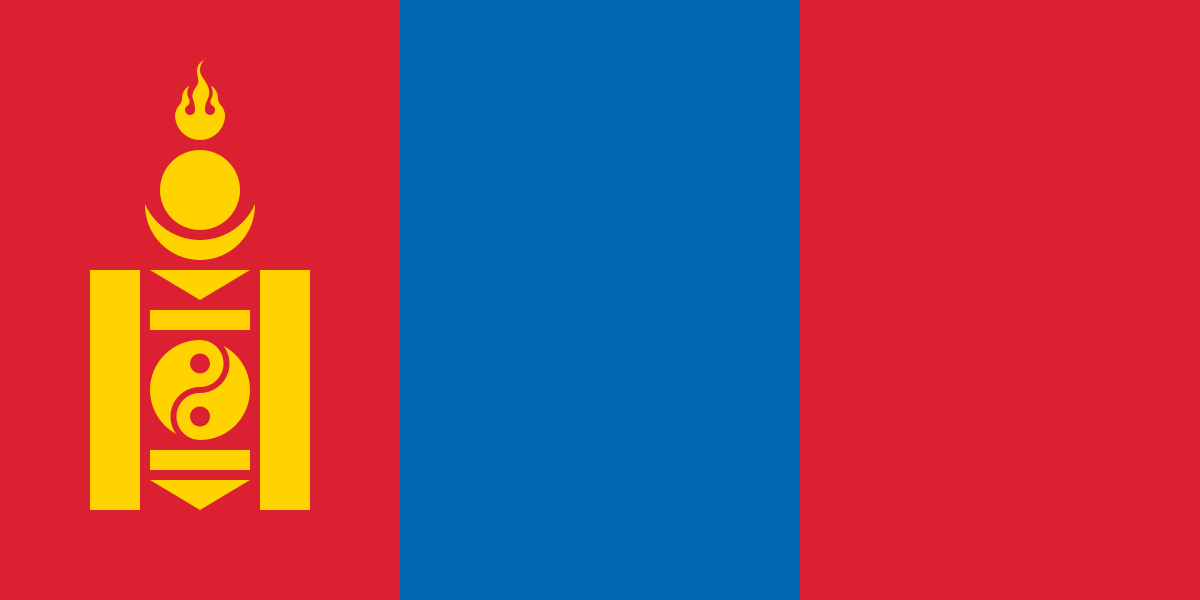
Mongolia is a landlocked country located in East Asia, nestled between Russia to the north and China to the south. The nation is characterized by its vast, rugged terrain, dominated by the Gobi Desert in the south and expansive grassland steppes that...
Your Mongolia Roadmap
40+ page relocation analysis tailored to your profile.
- Custom Tax & Cost Projection
- District Matching for your Lifestyle
- Vetted Local Partner Directory
With a safety index of 49/100, Mongolia offers moderate safety conditions for expats and their families.
Mongolia offers visa-free entry for citizens of numerous countries, including the United States, Canada, Germany, Japan, South Korea, UK, Australia, and New Zealand, making it accessible for short-term tourism and business travel. US, Canada, Germany, Japan, South Korea, and select others enjoy up to 90 days visa-free, while UK, Australia, most EU nations, and 34 countries total (extended until December 31, 2026) are limited to 30 days per visit.[1][3][4] All travelers must have a passport valid for at least six...
Discover Cities in Mongolia
Create your free profile to see personalized match scores.
33% below EU avg
25% below EU avg
53% below EU avg
34% below EU avg
Baselines based on EU averages. Source: Numbeo indices.
Capital
Ulan Bator
Timezone
UTC+07:00
Area
1,564,110 km²
Population
3,278,292
Mongolia shows a purchasing power index of 46/100, indicating moderate economic conditions for expats.
GDP
$16.81B
HDI
0.7
Quality of Life
32/100
-11 vs NYC
Purchasing Power
19/100
-23 vs NYC
Understanding the economic landscape is essential for evaluating living costs and opportunities in Mongolia. This comprehensive overview covers key financial indicators including cost of living, housing markets, income levels, and fiscal policies that shape daily life and long-term financial planning.
Cost of Living Index
Very affordable (CPI: 31.7, NYC=100). Groceries (35.9), restaurants (24.8), and rent (17.1) are low, ideal for expats.
Housing Market
Property prices average 11.4 years of household income. Rent index (17.1) offers affordability, with urban-rural variations.
Average Income Levels
Purchasing power index of 44.9 indicates below-average buying power. Mining-driven growth may improve incomes in urban areas.
Tax System
Flat 10% personal income tax, progressive for high earners up to 23%. VAT at 10%, simple and low rates with few regional variations.
Business Environment
Mining-focused economy with 5.7% growth in H1 2024, projected 5.3% for year. Regulatory improvements needed; ranks moderately in ease of business.
Social Security
Universal healthcare and pension system cover most citizens. Unemployment benefits exist but are modest; HDI 0.739 reflects average quality.
Mongolia experiences an extreme continental climate characterized by long, bitterly cold winters and short, warm summers. The country is high and dry, with an average elevation of 1,580 meters, creating pronounced seasonal temperature swings of up to 44°C between January and July.
4 distinct climate regions — see full guide for details
Read full guideLife Expectancy
73.0
Population
3,278,292
Religions
Ethnic Composition
Research in Progress
We're currently analyzing expat perspectives for Mongolia. Check back soon for insights from real experiences!
We're gradually rolling out this feature and continuously improving the insights. The data is based on real expat discussions and will become more comprehensive over time.
Mongolia operates as a semi-presidential republic with a unicameral 126-seat parliament (State Great Khural) and a directly elected president serving six-year terms. The country has experienced recent political tensions following the 2024 parliamentary elections, with factional divisions within the ruling Mongolian People's Party creating institutional challenges between the Prime Minister and parliamentary leadership.
Your Mongolia Roadmap
40+ page relocation analysis tailored to your profile.
- Custom Tax & Cost Projection
- District Matching for your Lifestyle
- Vetted Local Partner Directory
Population
3,278,292
Currency
MNT
Timezones
UTC+07:00 to UTC+08:00
Calling Code
+976
Week starts on
Monday
Gini Coefficient
32.7 (2018)
Traffic side
right side
Map coordinates not available for this location
Data Source: Safety, crime, and quality metrics are sourced from Numbeo, a crowd-sourced global database of reported data.
All scores are relative comparisons on a 0-100 scale, where 50 = global average. Higher scores mean better than average, lower scores mean worse than average.