
A country can look very different from the outside. A new government, headlines about German factories and talk of changing migration rules can make Hungary seem either newly open or suddenly closed. Neither description is quite right.
For someone deciding whether to move, the more useful question is simpler: can I build a workable life and career here under the rules that apply to me? In Hungary in 2026, the answer depends less on the headline of the day than on your passport, your permit route, whether you are moving with family, and the kind of work you do.
There has been a real change of government: Péter Magyar was sworn in as prime minister on 9 May 2026 and the new cabinet took office three days later. For residents and companies, the immediate relevance is practical rather than ceremonial: the government has signalled a focus on productivity, skilled work and a more predictable business environment, while reviewing parts of the tax and investment framework. It has also said it aims to meet euro-adoption criteria by 2030—an objective, not a date on which to base a salary, mortgage or moving plan. (Reuters
The clearest immigration change has gone in the opposite direction from a broad opening: Hungary stopped accepting new guest-worker residence permit applications in June. Yet EU citizens retain free-movement rights, the EU Blue Card remains available for qualifying specialists, and ordinary employment routes have not disappeared. Meanwhile, Hungary's German business story is substantial but more nuanced than "companies are leaving Germany for Hungary": there are confirmed production moves and major investments, but no evidence of a wholesale corporate exodus.
General information, not legal, tax or immigration advice. This guide is a practical introduction based on information verified through 4 August 2026. Individual outcomes depend on nationality, purpose of stay, family circumstances and the rules in force when you apply.
The good news is that Hungary is not a yes-or-no proposition. It is a selective one. The following quick portrait gives you the decision before the detail.
| Quick portrait | What it means for you |
|---|---|
| EU/EEA national | You can work without a work permit; a stay beyond 90 days requires a Registration Certificate notified through Enter Hungary by the 93rd day from entry. (Enter Hungary) |
| Third-country specialist | The EU Blue Card remains a defined route, but its 2026 salary floor is HUF 1,001,048 gross a month, so it fits higher-paid specialist roles rather than the typical national wage. (OIF; KSH) |
| Family move | Several permit categories—including employment-purpose and White Card—exclude family reunification, so the permit comes before the property search. (OIF employer factsheet) |
| German-speaking professional | An established German corporate base offers a credible starting point, particularly around automotive, engineering, R&D and business services. (Auswärtiges Amt; Gyártástrend) |
| Employer using agency labour | The new guest-worker closure is a material staffing risk, and the replacement framework was still unresolved at the verification date. (CMS; Portfolio.hu) |

Lake Balaton. Foto von Márton Pótó auf Unsplash
A new government: direction of travel, not a blank slate
Hungary's April 2026 election produced a parliamentary majority for Tisza, followed by the May handover. The incoming programme put taxes, EU funds, energy, productivity and skilled employment on the agenda. It proposed VAT cuts on selected goods, income-tax relief for lower earners and a review of tax benefits, while keeping sectoral taxes in place for the time being.
The distinction that matters to a mover is between an announcement and a rule you can plan around. The proposed low-earner income-tax relief, VAT reductions, euro debate, productivity focus and review of Paks financing describe a policy programme. They do not automatically alter an offer letter, a residence card or a household budget.
Some measures are more concrete. The summer tax package includes dated changes to trust taxation and corporate incentives; the special immigration tax and municipal tax are set to be abolished from 2027. The package also says a stricter invoice-level VAT M-sheet requirement planned from the period including 1 July 2026 will not be introduced.
For companies, the transition improved sentiment without erasing underlying concerns. In the German-Hungarian Chamber of Industry and Commerce (DUIHK) survey, the share of respondents expecting their own business to improve rose from 24% before the election to 35% afterwards; Reuters reported that 25% of surveyed firms said the result had increased their willingness to invest. Energy prices were the leading business risk in the chamber's survey, with labour costs and skills shortages also prominent.
That is a useful frame for a relocation: Hungary is an established industrial and services location in political and administrative transition. Treat the policy mood as context. Treat your employment contract, permit category and household plan as the decision.
Start with the permit, not the plane ticket
The biggest mistake a prospective mover can make is to choose a city before choosing a lawful route. In 2026, the guest-worker closure made this even clearer.
Since 5–6 June, Hungary has accepted no new guest-worker residence permit applications because the government designated no eligible third countries for that permit type and withdrew the earlier country list. The measure particularly changed agency-led recruitment from the Philippines, Georgia and Armenia. Existing permits stayed valid; procedures filed and paid for by 5 June, plus then-applicable extensions and reissuance, were not disturbed by the decree.
This closed the previous large-scale temporary-labour channel. It did not end all non-EU work migration. The route you use will determine your duration, income test, employer duties and, crucially, whether your spouse or children can join you.
| Route | Practical 2026 position | Key planning point |
|---|---|---|
| EU/EEA registration | Work needs no work permit; for stays over 90 days, notify the Registration Certificate through Enter Hungary by day 93. (Enter Hungary) | The clearest route for an employed, self-employed, job-seeking or qualifying family mover. (Enter Hungary) |
| Employment-purpose permit | Available for up to two years, extendable by one year to a three-year maximum; the employer generally has to demonstrate a labour shortage. (OIF employer factsheet) | A job offer alone is not the whole test. (OIF employer factsheet) |
| EU Blue Card | Available for up to four years and renewable; the 2026 gross monthly floor is HUF 1,001,048, or HUF 800,838 for listed health professions. (OIF) | Suitable for a qualifying senior or specialist package. (OIF) |
| White Card | A remote worker with a foreign employer or business needs at least EUR 3,000 net monthly income for the preceding six months; the card is valid for one year and extendable once. (Jogpro) | It requires no Hungarian employer or client. (Jogpro) |
| Guest-worker permit | No new applications since 5–6 June 2026. (CMS) | Do not build a new move or recruitment plan around this closed channel. (CMS) |
| Intra-corporate transfer / posting | The OIF factsheet lists transfers of up to three years for executives and experts, one year for trainees, and postings of up to two years. (OIF employer factsheet) | These are employer-structure routes, not a substitute for an unsupported direct hire. (OIF employer factsheet) |
The official landscape also includes seasonal employment of up to six months, investment-purpose employment of up to three years, the Hungarian Card for specified qualifying roles and the National Card for restricted nationalities. These are real categories, but each has its own conditions; they should not be treated as generic fallbacks when a standard employment application is difficult.
A quota still exists in the background: the 2026 cap for employment-related and guest-worker residence permits is 35,000, unchanged from 2025. The cap does not apply to the National Card, Hungarian Card or EU Blue Card.
For families, the permit question is not a technicality. It determines whether a move is viable at all. The official employer factsheet excludes family reunification for holders of employment-purpose, guest-worker, seasonal, investment-purpose employment, White Card and study/training permits. That means a role can be excellent for one person and fundamentally wrong for the household they hope to bring.
| Your household plan | Is the path workable on the stated route? | What to do before committing |
|---|---|---|
| EU/EEA citizen moving with family | EEA registration recognises family membership as a qualifying purpose; third-country family members receive a Residence Card. (Enter Hungary) | Confirm the family member's documentation and submit the relevant registration/card process. (Enter Hungary) |
| Employment-purpose permit holder with spouse/children | Blocked for family reunification on that permit category. (OIF employer factsheet) | Resolve the household's separate lawful basis before accepting the job. (OIF employer factsheet) |
| White Card remote worker with family | Blocked for family reunification on the White Card. (OIF employer factsheet) | Do not treat it as a standard family digital-nomad route. (OIF employer factsheet) |
| Seasonal, guest-worker, investment-purpose or study/training holder with family | Blocked for family reunification on the listed categories. (OIF employer factsheet) | Seek tailored immigration advice before a household commitment. (OIF employer factsheet) |
| Blue Card or other route not named in the exclusion | The exclusion list does not itself establish eligibility; permit-specific rules still matter. (OIF employer factsheet) | Confirm the exact category and current family rules with the competent authority. (OIF employer factsheet) |
The employer's administrative job does not end at sponsorship. Accommodation must be registered within three days, extensions must be filed at least 30 days before expiry through Enter Hungary, and the stated procedure is 21 days within an overall 60–70 days. Notification failures can bring fines of up to HUF 1 million per employee; failures linked to ensuring a guest worker's departure after employment ends can attract HUF 5 million, and a 30% breach rate can trigger a two-year ban on employing new guest workers.
The sensible corporate response is neither panic nor complacency. Government Decision 1153/2026 ordered an urgent review of foreign-employment rules, and employers and experts proposed a nationality-independent general work permit with an individual labour-market test in July. No replacement framework had been adopted by the verification date, while Dentons reported that the EU single-permit directive will require amendments to the Hungarian framework.
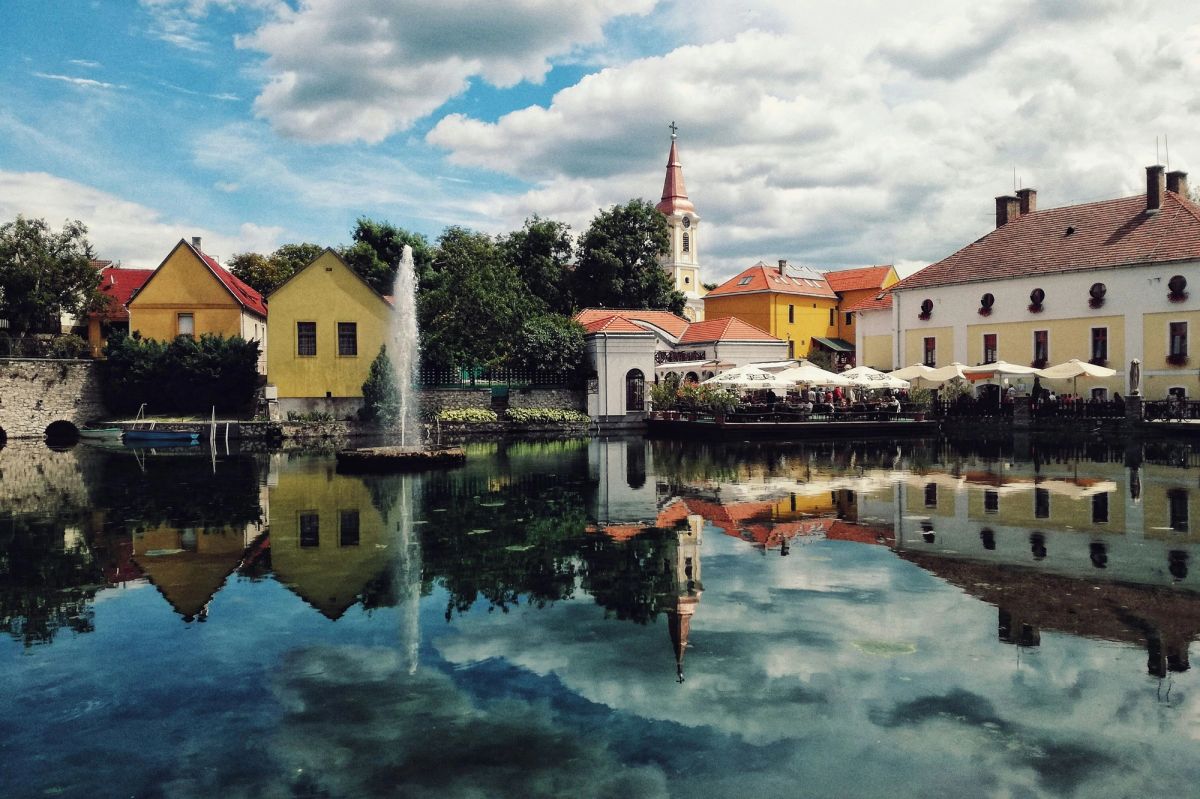
Tapolca, Hungary, Photo by Matze Bob on Unsplash
German business: real depth, no exodus shortcut
German-speaking professionals are not looking at a blank map. Germany is Hungary's largest economic partner; the German Federal Foreign Office says around 3,000 German companies operate in Hungary, employing about 300,000 people, and the DUIHK has more than 900 members.
That long-standing presence helps explain why automotive, engineering, R&D and business services are sensible places to start a job search. It also explains why "Budapest or nothing" is the wrong map: 84% of HIPA-supported projects in 2025 were outside the capital, making industrial locations such as Kecskemét, Debrecen, Szeged and Győr particularly relevant to certain offers.
Recent news deserves neither dismissal nor exaggeration. Mercedes-Benz confirmed that entry-level A-Class production would move from Rastatt to Kecskemét from the second quarter of 2026 as part of a flexible production network, freeing capacity in Rastatt for future models. Mercedes said the move would not affect jobs at Rastatt. That is a verified line-level production decision, not a report that Mercedes has relocated its company or headquarters.
| Verified move or project | What is confirmed | Status to use in a decision |
|---|---|---|
| Mercedes A-Class: Rastatt → Kecskemét | Production was confirmed to move from Q2 2026 within a flexible network, with no stated impact on Rastatt jobs. (Reuters) | Confirmed production reallocation—not a corporate exodus. (Reuters) |
| Mercedes Kecskemét expansion | Mercedes opened the expansion in July after about €1bn investment; its site describes new production facilities, battery assembly and more than 5,000 employees. (Mercedes-Benz Group) | The government's +3,000-jobs figure is an announcement; Reuters recorded nearly 5,200 employees at end-May, not filled new posts. (Reuters) |
| BMW Debrecen ramp-up | A second shift began early in February 2026 and a third was being prepared for September; BMW referred to more than 5,000 employees contributing to the milestone. (BMW Group PressClub Hungary) | Confirmed ramp-up, useful for role-specific research. (BMW Group PressClub Hungary) |
| ZF / Rheinmetall supplier projects | A compiled investment record lists ZF's Debrecen axle-module investment and Rheinmetall's Szeged hybrid plant, among others. (JEBridge) | Supplier evidence, not evidence that every announced role is open or filled. (JEBridge) |
| Bosch production shift | Bosch planned to phase out production at Sebnitz and Leinfelden by end-2026, with production relocating to Hungary as more cost-effective. (Hungary Today) | One confirmed shift; do not turn it into a general rule. (Hungary Today) |
The broader picture is more measured. In the German-Central and Eastern European Business Outlook, Hungary was the intended destination for 19% of German companies planning CEE investment in 2026—the same share as in 2025—and the study said investment in Hungary had declined compared with the prior year.
This does not weaken the case for a good role. It simply changes the way to pursue one. Assess the actual team, working language, shift pattern, location and permit support. No retrieved evidence quantifies which Hungarian roles can be carried out in English or German without Hungarian, so this is a question to ask an employer directly rather than an assumption to make.
For employers, HIPA reported 108 supported 2025 investment decisions worth €7.069bn and 18,227 new jobs, and independent reporting recorded 14 R&D projects worth about €570m and around 600 jobs plus record business-service-centre job creation. These are investment-promotion and announced-project figures, not a census of realised capital expenditure or filled vacancies.
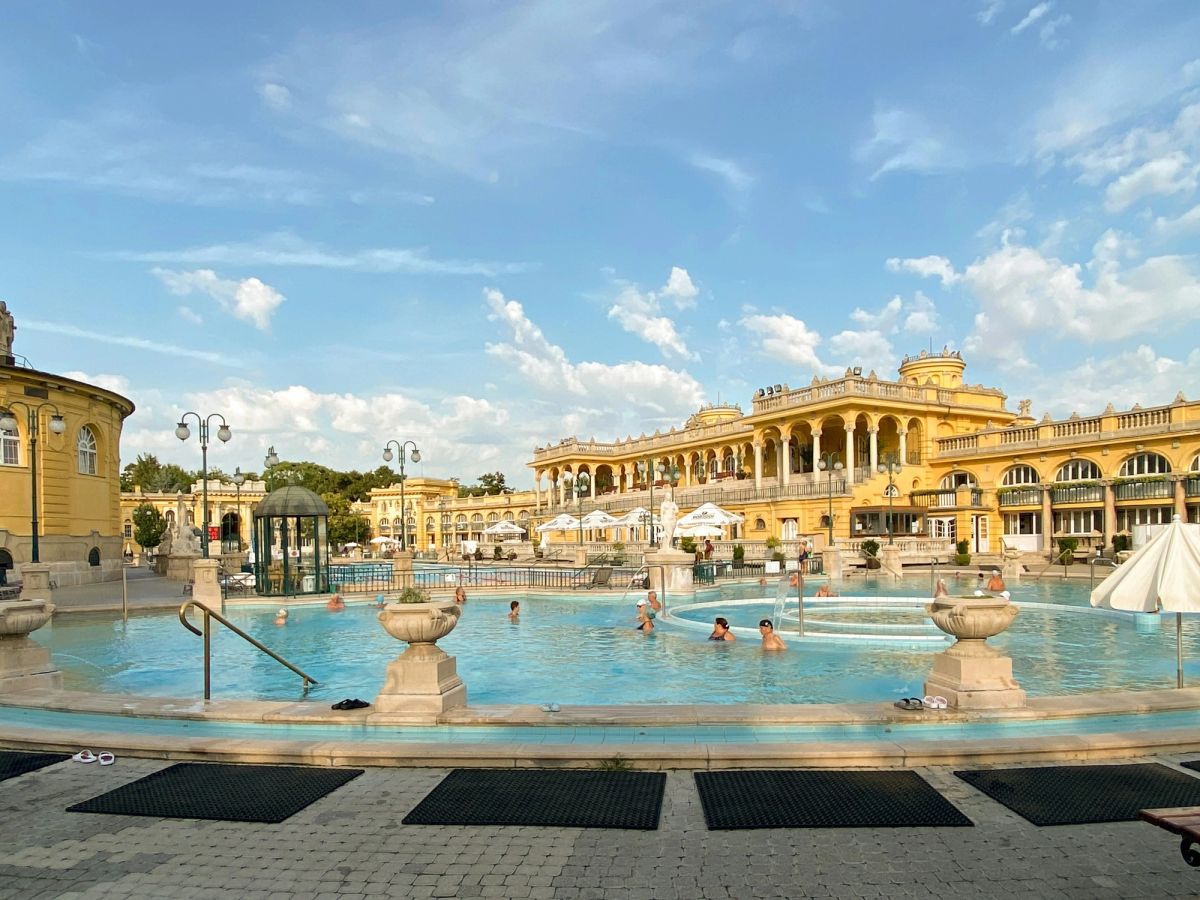
The Szechenyi Thermal Baths in Budapest, Hungary on a summer morning. Photo by Linda Gerbec on Unsplash
The job market: tight headline, selective reality
Hungary's labour market sends two signals at once. June 2026 unemployment was 4.4% on the KSH measure and 4.5% on the harmonised Eurostat measure, below the EU's 6.0%. That is a relatively tight headline market.
But a low unemployment rate does not guarantee a quick offer. Employment had fallen by roughly 100,000 over two years by April 2026. The vacancy rate was 2.1% in the first quarter, unchanged from the prior two years, while vacancies fell from 70,125 in early 2024 to 66,113 in early 2026. Average job-search duration was 12.5 months, and 35.3% of unemployed people had been looking for at least a year.
That combination points to a matching problem: employers need particular skills, locations and work patterns; applicants are not automatically a match. KSH's vacancy measure also excludes posts to be filled by subcontractors, labour-force lending, casual-work assignment, internal transfer, unpaid apprentices and public workers, so it cannot fully show agency-labour demand.
| Labour-market indicator | Latest cited figure | How to read it |
|---|---|---|
| Unemployment rate | 4.4% in June 2026; 4.5% harmonised, against 6.0% in the EU. (KSH; Eurostat) | A tighter headline market than the EU average. (Eurostat) |
| Job vacancies | 66,113 and a 2.1% rate in 2026 Q1, down from 70,125 in 2024 Q1. (KSH vacancy statistics) | Shortages are selective rather than a simple excess of jobs. (KSH vacancy statistics) |
| Job-search duration | 12.5 months average; 35.3% of unemployed people were long-term unemployed. (KSH) | A tailored application still matters. (KSH) |
| Manufacturing vacancies | 13,912 and a 2.0% rate in 2026 Q1. (KSH vacancy statistics) | Manufacturing opportunity is real, but not automatically broad-based. (KSH vacancy statistics) |
| Foreign-worker count | Official statements place foreign workers at about 2% of the workforce, but no precise total exists across 24 work categories. (Reuters; Telex English) | Avoid false precision in staffing plans. (Telex English) |
Pay gives a second reality check. In May 2026, average gross monthly earnings were HUF 764,100 and median gross monthly earnings were HUF 615,600. The statutory minimum wage was HUF 322,800 gross a month from 1 January 2026, while the guaranteed minimum for qualifying vocational or secondary roles was HUF 373,200.
| Salary or permit benchmark | 2026 figure | Decision use |
|---|---|---|
| Average gross monthly earnings | HUF 764,100 in May. (KSH) | A national reference point, not a sector salary guide. (KSH) |
| Median gross monthly earnings | HUF 615,600 in May. (KSH) | A useful check against offers close to the middle of the distribution. (KSH) |
| Statutory minimum wage | HUF 322,800 gross/month. (Leinonen Hungary) | The legal floor for a standard full-time role. (Leinonen Hungary) |
| Guaranteed minimum wage | HUF 373,200 gross/month for qualifying vocational/secondary roles. (Accace) | Relevant to roles requiring the stated qualification. (Accace) |
| EU Blue Card | HUF 1,001,048 gross/month; HUF 800,838 for listed health professions. (OIF) | A materially above-average, specialist-level threshold. (OIF; KSH) |
| White Card | EUR 3,000 net/month for the previous six months. (Jogpro) | A remote-work income test, not a local salary. (Jogpro) |
The Blue Card comparison is especially useful. Its general threshold is well above the national average gross wage. That does not make Hungary unsuitable for a specialist; it means the route is designed for a properly paid specialist position, and an offer near the threshold should be checked carefully before anyone relocates.

Hegymagas, Hungary. Photo by Matze Bob on Unsplash
Daily life is a spreadsheet before it becomes a lifestyle
A move succeeds or fails in ordinary details: the net offer, the commute, the school or partner plan, and whether the permit is renewable. Hungary's personal income tax is a flat 15%, with employee social-security contributions of 18.5%; employer social-contribution tax is 13%.
Those figures are a starting point, not a personalised payroll calculation. They are particularly important when comparing a Budapest offer against one in an industrial city, or comparing local employment with a foreign remote contract. A company should also update rather than assume its cost case: DUIHK reported Hungarian wage-cost growth of 75% between 2020 and 2025, even though absolute labour costs remained comparatively low regionally.
Budapest is the obvious reference point for many international movers, but it is not the entire opportunity set. Automotive and engineering offers often place the household near Kecskemét, Debrecen, Szeged or Győr. The better question is not "Is Hungary affordable?" but "Does this specific salary support this specific location and family structure?"
Published rental and cost guides can help form the first draft of a budget, but they are not official statistics. One index-based guide put early-2026 Budapest one-bedroom rents at roughly HUF 260,000 a month, with a HUF 180,000–380,000 range; another Numbeo-based guide estimated a single person's comfortable central-Budapest monthly budget at HUF 490,000–560,000, including a one-bedroom. Treat both as indicative prompts to obtain current local listings and a tailored budget, not as a decision-grade forecast.
Energy belongs in the company and household risk conversation, even if it cannot be forecast from one summer event. Energy prices were the top risk in the DUIHK survey, and Telex reported on 30 July that the Paks nuclear plant might have to shut all units because of a record-low Danube water level, potentially removing about 2,000 MW against 3,600–3,800 MW of import capacity.
Who should move forward—and who should pause?
The decision is most straightforward for EU/EEA nationals who have a concrete role and a workable household plan. Their right to work does not depend on an employer work permit, and their longer stay uses the registration process rather than the third-country work-permit landscape.
It can also be a strong option for German-speaking specialists in automotive, engineering, R&D and business services. The German corporate ecosystem, confirmed Mercedes and BMW activity, and 2025 R&D and business-services project pipeline make that a grounded opportunity rather than a slogan.
Senior specialists with an offer at or above the Blue Card threshold have a defined pathway. Remote professionals with a foreign employer or business and the required EUR 3,000 net monthly income can consider the White Card, but only if its no-Hungarian-client condition and lack of family reunification suit the plan.
Local employees should read the market with the same discipline. The low unemployment rate is encouraging, but the long job-search duration, flat vacancy rate and falling employment base argue for targeted applications, salary comparison and specific questions about language, shifts and location.
The clearest pause signal is a family plan built on an excluded permit. It is also a pause signal for third-country blue-collar workers or agencies relying on the new guest-worker route, and for employers whose staffing model assumes rapid agency supply from outside the EU. The closure is real, the employer penalties are material, and the post-closure framework remained uncertain at the verification date.

Szentendre, Hungary. Photo by Linda Gerbec on Unsplash
Your practical 30-day Hungary checklist
Use the first month to convert interest into evidence. The sequence below deliberately puts eligibility and household viability before housing deposits, resignation notices or recruitment targets.
| When | Your action | What a good answer looks like |
|---|---|---|
| Days 1–3 | Identify your passport category and exact residence route. (Enter Hungary; OIF employer factsheet) | You can name the applicable route and its duration, income or employer test. (OIF employer factsheet) |
| Days 4–7 | Test the family plan against the permit category before signing a lease or accepting an offer. (OIF employer factsheet) | Every family member has a viable lawful basis; you are not relying on family reunification where it is excluded. (OIF employer factsheet) |
| Week 2 | Compare the gross offer with the average, median, minimum wage and, if relevant, Blue Card threshold. (KSH; OIF; Leinonen Hungary) | You understand whether the offer is a local-market, specialist or permit-threshold package. (KSH; OIF) |
| Week 2 | Ask the employer about working language, exact location, shifts, permit support and start-date dependencies. (Debrecen4U; OIF employer factsheet) | The job is a named role with a location and compliance owner—not only an investment announcement. (Reuters) |
| Week 3 | Create a city-specific budget using current listings; treat published rent indexes only as starting ranges. (Investropa; Budapest Expat) | The budget reflects the actual city, commute and household rather than a generic Hungary average. (Hungarian Conservative) |
| Week 3 | For employers, map each foreign hire to the correct route, filing timeline and notification duty. (OIF employer factsheet) | Accommodation, extension deadlines and post-employment duties have a named owner. (OIF employer factsheet) |
| Week 4 | Check whether the plan relies on a closed or unsettled guest-worker channel, then seek current professional advice where it does. (CMS; Portfolio.hu) | You have a lawful alternative or a reason to defer the move or hire. (CMS) |
| Day 30 | Decide only after the route, family plan, role and budget all work together. | You are choosing a documented plan rather than a headline. |
The balanced conclusion
Hungary in 2026 is worth serious consideration for EU/EEA citizens, properly paid senior specialists, German-speaking professionals with a specific role, and remote workers whose foreign-income and solo-move profile fits the White Card. Its attraction lies in a real industrial and services base, established German business links and identifiable opportunities—not in a promise that every move will be easy.
Pause if your plan depends on the closed guest-worker route, assumes family reunification where the permit excludes it, or treats announced factory jobs as filled vacancies. Pause, too, if the only budget is a generic rent index or the only job-market thesis is a low unemployment rate.
The fairest verdict is not that Hungary has become broadly easier or harder. It has become more selective. Bring the right route, a genuine role and a realistic daily-life plan, and the move can be credible. If one of those three pieces does not yet work, the best decision may be to pause long enough to make it work.


