


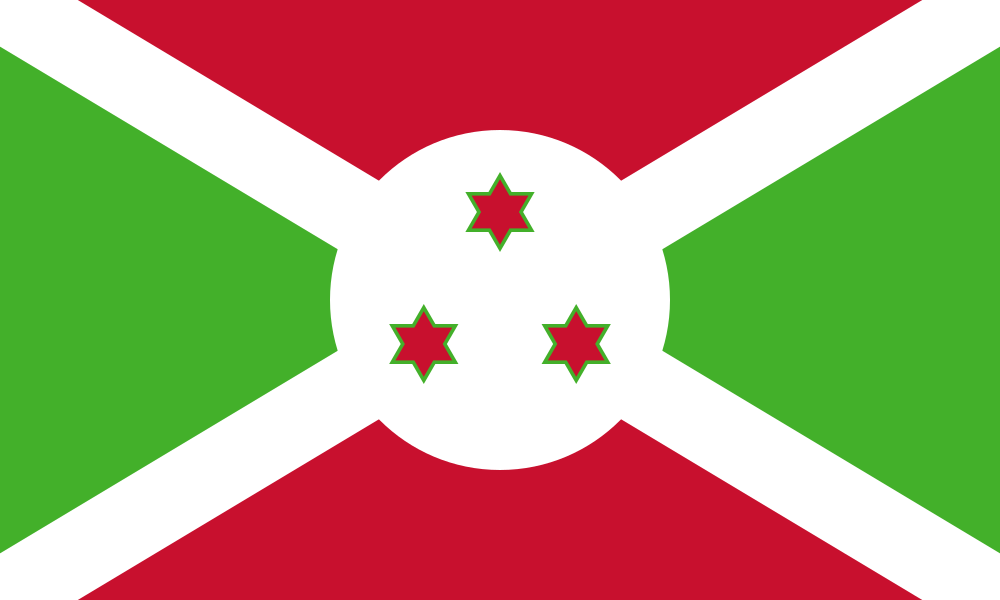
Burundi
Burundi is a small, landlocked country located in the African Great Lakes region of East Africa, bordered by Rwanda, Tanzania, and the Democratic Republic of the Congo. Situated in a region of rolling hills and mountains, the country has a predominan...
Your Burundi Roadmap
40+ page relocation analysis tailored to your profile.
- Custom Tax & Cost Projection
- District Matching for your Lifestyle
- Vetted Local Partner Directory
With a safety index of 43/100, Burundi offers moderate safety conditions for expats and their families.
Burundi offers visa-on-arrival for most international visitors, including citizens of the United States, United Kingdom, Canada, and Australia. Travelers can obtain a tourist visa upon arrival at Bujumbura International Airport, provided they have previously informed their travel agency of their passport number, identity, and flight details[3]. The single-entry tourist visa costs $70 USD and is valid for 1 month, while a multi-entry tourist visa costs $90 USD and is also valid for 1 month[3]. Processing for visa-on-arrival typically takes 1-3...
Discover Cities in Burundi
Create your free profile to see personalized match scores.
13% below EU avg
33% below EU avg
59% below EU avg
Baselines based on EU averages. Source: Numbeo indices.
Capital
Gitega
Timezone
UTC+02:00
Area
27,834 km²
Population
11,890,781
Burundi shows a purchasing power index of 28/100, indicating below average economic conditions for expats.
GDP
$3.34B
HDI
0.4
Quality of Life
N/A
NYC baseline: 43
Purchasing Power
12/100
-30 vs NYC
Understanding the economic landscape is essential for evaluating living costs and opportunities in Burundi. This comprehensive overview covers key financial indicators including cost of living, housing markets, income levels, and fiscal policies that shape daily life and long-term financial planning.
Cost of Living Index
Very affordable. Groceries index: 43.8, Restaurant index: 36.2. Significantly lower costs than major global cities, making it highly accessible for residents.
Housing Market
Extremely expensive relative to income. Property prices average 32.2 years of household income. Rent index of 11.3 is low, but property ownership remains severely unaffordable.
Average Income Levels
Very low purchasing power. GDP per capita approximately $836 (PPP). Majority of population engaged in subsistence agriculture with limited formal employment opportunities.
Tax System
Limited information available on current tax structure. Burundi faces significant fiscal challenges and IMF structural adjustment programs. Tax system lacks transparency and enforcement capacity.
Business Environment
Challenging conditions for business. Landlocked country with limited industrialization, high transport costs, and uncertain security situation deterring foreign investment. Minimal formal business infrastructure.
Social Security
Weak social safety net. Limited healthcare and pension coverage. Agriculture supports 70% of labor force with minimal formal social protections. Healthcare and social services severely underfunded.
Burundi features a temperate highland tropical climate with minimal seasonal temperature variation due to its equatorial location and elevation between 770-2,684 meters. Temperatures remain mild year-round, typically ranging from 17-27°C, making it comfortable for residents and expats.
3 distinct climate regions — see full guide for details
Read full guideLife Expectancy
57.5
Population
11,890,781
Religions
Ethnic Composition
Research in Progress
We're currently analyzing expat perspectives for Burundi. Check back soon for insights from real experiences!
We're gradually rolling out this feature and continuously improving the insights. The data is based on real expat discussions and will become more comprehensive over time.
Burundi is a presidential republic where the CNDD-FDD, a former rebel group turned ruling party, has dominated politics since 2005 and secured a landslide victory in June 2025 elections. The country operates under a 2005 constitution requiring ethnic power-sharing between Hutus and Tutsis, though democratic institutions have been significantly weakened through restrictions on opposition parties, media censorship, and electoral irregularities. International observers and human rights organizations have documented severe constraints on political freedoms and describe Burundi's governance as increasingly authoritarian.
Your Burundi Roadmap
40+ page relocation analysis tailored to your profile.
- Custom Tax & Cost Projection
- District Matching for your Lifestyle
- Vetted Local Partner Directory
Data Source: Safety, crime, and quality metrics are sourced from Numbeo, a crowd-sourced global database of reported data.
All scores are relative comparisons on a 0-100 scale, where 50 = global average. Higher scores mean better than average, lower scores mean worse than average.