


Review carefully
Quality of life index out of 100
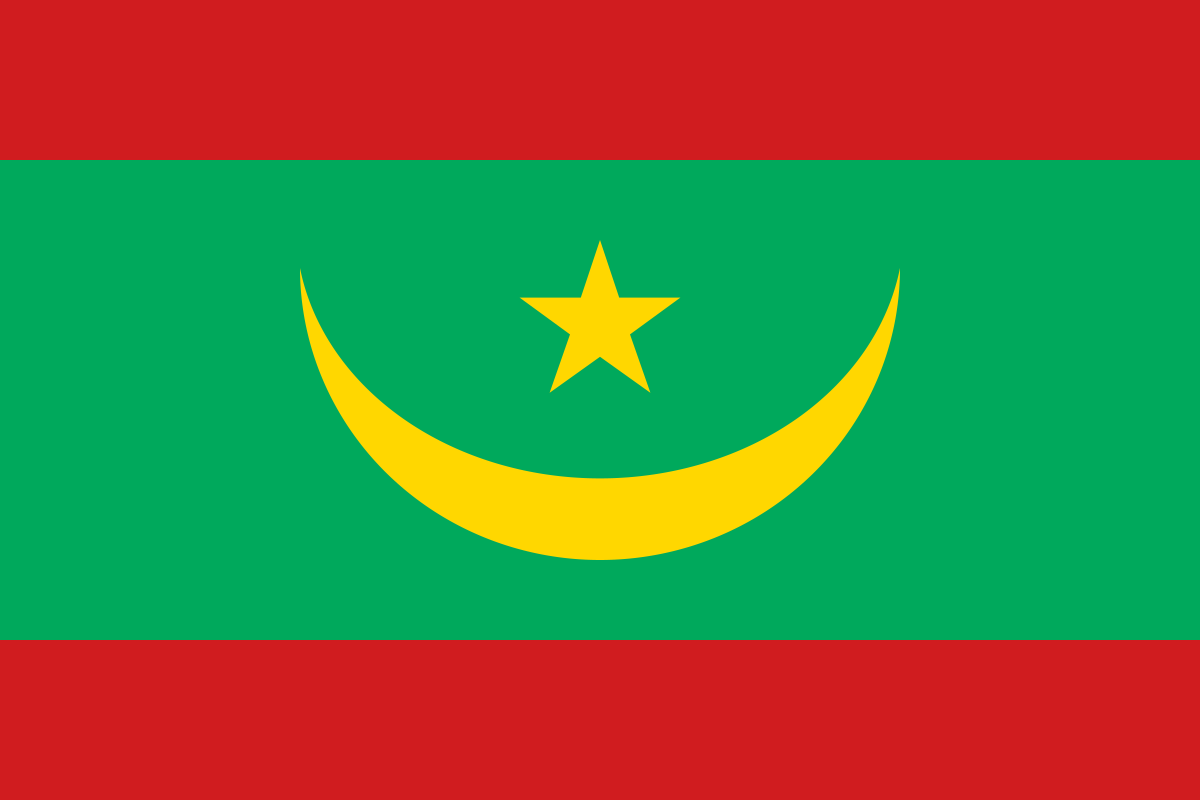
Mauritania
Atlantic Ocean · Arabic
Mauritania
Mauritania is a vast West African nation situated in the Maghreb region, characterized by its expansive desert landscapes and strategic location along the Atlantic coast. Predominantly covered by t…
What it's like to live in Mauritania· AI overview
Mauritania is a vast West African nation situated in the Maghreb region, characterized by its expansive desert landscapes and strategic location along the Atlantic coast. Predominantly covered by the Sahara Desert, the country spans approximately 1,0...
Your Mauritania Roadmap
40+ page personal relocation analysis — visa path, tax strategy, neighbourhood guide, healthcare setup and more.
- ✓Visa & residency path
- ✓Tax optimisation
- ✓Neighbourhood guide
- ✓Healthcare & schools
- ✓Cost breakdown
With a safety index of 62/100, Mauritania offers good safety conditions for expats and their families.
Most international travelers, including citizens of the United States, United Kingdom, Canada, Australia, and EU countries, require a visa to enter Mauritania. However, a visa on arrival is available at Nouakchott–Oumtounsy International Airport for up to 30 days as a single-entry permit. This option is convenient for tourists but limited to air arrivals; land border entrants must obtain visas in advance. Passports must have at least six months validity and one blank page, plus a yellow fever vaccination certificate is...
Discover Cities in Mauritania
View all cities in MauritaniaCreate your free profile to see personalized match scores.


Mauritania shows a purchasing power index of 48/100, indicating moderate economic conditions for expats.
GDP
$10.38B
Total economic output of the country
HDI
0.56
Medium human development
Quality of Life
N/A
Composite score based on cost of living, safety, healthcare & climate
Purchasing Power
20/100
Weak purchasing power — salaries don't stretch far
Understanding the economic landscape is essential for evaluating living costs and opportunities in Mauritania. This comprehensive overview covers key financial indicators including cost of living, housing markets, income levels, and fiscal policies that shape daily life and long-term financial planning.
Cost of Living Index
Housing Market
Average Income Levels
Tax System
Business Environment
Social Security
Tax information is currently being researched.
Climate
Mauritania features an arid to hyperarid climate dominated by desert conditions, with 90% of its territory in the Sahara. It has two seasons: a hot season from March to October with temperatures exceeding 40°C in deserts, and a cooler season from November to February averaging 25-30°C.
Hot Desert, Hot Semi-Arid
30–45°C
15–30°C
3500+ hrs/yr
3 distinct climate regions — see full guide for details
Read full guideDemographics in Mauritania
Ethnic Composition
Long-term Expat Guide in Mauritania
Gallery for Mauritania
20 photosEconomic overview
Purchasing power
Work & Business
- Employment rate: 49.6%
- Salary range: MRU 1,200,000–MRU 2,400,000/year
- Startup ecosystem: 4.2/10
- Business registration: 2-4 weeks
- Top industries: Mining & Extractive Industries, Oil & Gas Energy, Fisheries & Aquaculture, Agriculture & Agribusiness, Financial Services & Banking
- No specific remote work legislation identified. Remote work framework not formally codified in na…
Gesundheitsversorgung in Mauritania
Retirement & benefits
Transportation
Mauritania's transportation and infrastructure landscape reflects a developing nation with strategic positioning linking North Africa, the Sahel, and Atlantic trade routes. The country is undergoing significant modernization, particularly through a US$275 million railway rehabilitation program and the Nouakchott Sustainable Urban Mobility Plan launched in 2023. While road networks show unequal distribution with lower-income regions lacking connectivity, major initiatives focus on expanding public transport coverage, improving accessibility for marginalized communities, and strengthening the critical Zouerate-Nouadhibou railway corridor that serves as the backbone of mineral exports.
Transportation guideRecht & Verwaltung in Mauritania
Legal & Administrative in Mauritania
Environment & Sustainability in Mauritania
Mauritania operates as a presidential republic under President Mohamed Ould Ghazouani, who won re-election in 2024 amid efforts to consolidate power. The unicameral National Assembly is dominated by the ruling El Insaf party following 2023 elections. Political stability has improved with electoral reforms, though hyper-presidentialism persists.
Ready to stop
browsing and start moving?
Generate a personalized relocation roadmap — visa path, 3 shortlisted cities, tax & timeline.
Data Source: Safety, crime, and quality metrics are sourced from Numbeo, a crowd-sourced global database of reported data.
All scores are relative comparisons on a 0-100 scale, where 50 = global average. Higher scores mean better than average, lower scores mean worse than average.
Social Integration
Social integration in Mauritania is challenging due to its predominantly Muslim, Arabic-speaking population, vast desert geography, and limited urban infrastructure primarily in Nouakchott. Government policies support refugee integration into labor markets and public services, but expat communities are small with scarce online forums or Reddit discussions (r/Mauritania has minimal activity). Locals show hospitality per cultural norms, yet language barriers and conservative social structures hinder newcomer integration.
Social integration guideEnvironment & Sustainability
Mauritania, a Sahelian nation, faces severe environmental challenges from recurring droughts, desertification, and climate change impacts on water, agriculture, and food security. With limited data on air quality (stable trend) and sustainability metrics (all N/A), the country has updated its NDC to cut emissions by 11% by 2030 and focuses on adaptation in ecosystems, water, and agriculture. Climate disasters like droughts significantly affect growth, mitigated somewhat by efforts in electricity access and health.
Environment guide