


Worth considering
Quality of life index out of 100
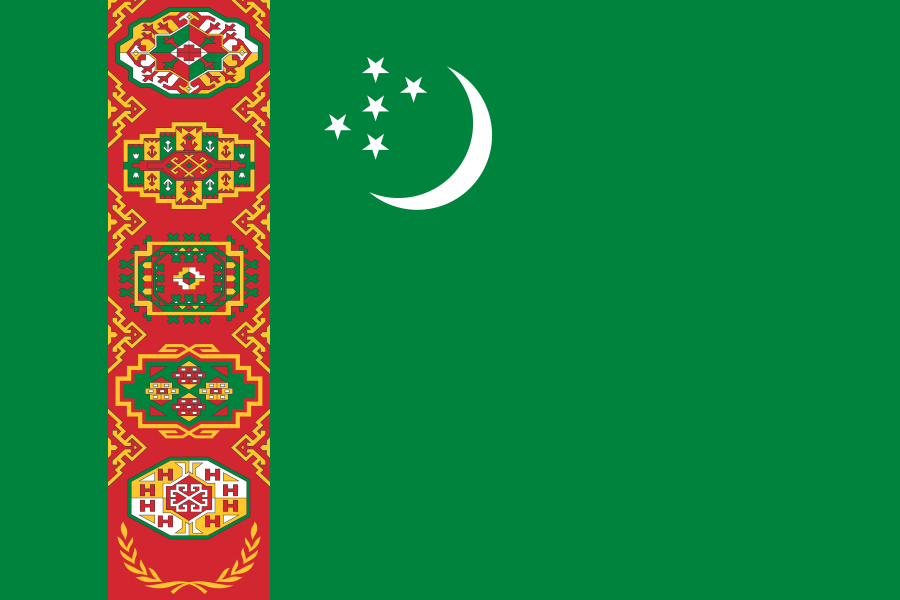
Turkmenistan
Russian
Turkmenistan
Turkmenistan is a landlocked country located in Central Asia, bordered by Kazakhstan, Uzbekistan, Afghanistan, and Iran. Predominantly covered by the Karakum Desert, the nation features a harsh, ar…
What it's like to live in Turkmenistan· AI overview
Turkmenistan is a landlocked country located in Central Asia, bordered by Kazakhstan, Uzbekistan, Afghanistan, and Iran. Predominantly covered by the Karakum Desert, the nation features a harsh, arid landscape characterized by extreme temperatures an...
Your Turkmenistan Roadmap
40+ page personal relocation analysis — visa path, tax strategy, neighbourhood guide, healthcare setup and more.
- ✓Visa & residency path
- ✓Tax optimisation
- ✓Neighbourhood guide
- ✓Healthcare & schools
- ✓Cost breakdown
With a safety index of 53/100, Turkmenistan offers moderate safety conditions for expats and their families.
Turkmenistan requires a visa for all international visitors, including citizens of the United States, United Kingdom, Canada, and Australia, with no visa-free entry available for tourism.[9][5][6] Travelers must obtain a Letter of Invitation (LOI) certified by the State Migration Service of Turkmenistan, typically arranged through a licensed tour agency for tourist visas, before applying at an embassy/consulate or airport.[4][1][2] Visa on arrival is available at Ashgabat International Airport and select land borders (e.g., with Uzbekistan, Iran), but requires the original...
Discover Cities in Turkmenistan
View all cities in TurkmenistanCreate your free profile to see personalized match scores.


Turkmenistan shows a purchasing power index of 19/100, indicating below average economic conditions for expats.
GDP
$64.24B
HDI
0.7
Quality of Life
47/100
+4 vs NYC
Purchasing Power
9/100
-33 vs NYC
Understanding the economic landscape is essential for evaluating living costs and opportunities in Turkmenistan. This comprehensive overview covers key financial indicators including cost of living, housing markets, income levels, and fiscal policies that shape daily life and long-term financial planning.
Tax information is currently being researched.
Climate
Turkmenistan features a predominantly arid continental climate dominated by the vast Karakum Desert, classified primarily as cold semi-arid (BSk) and cold desert (BWk) under Köppen system. Summers are intensely hot with averages of 27-29°C and peaks near 50°C, while winters remain mild at 8-9°C with occasional frosts to -15°C or lower in northern areas.
Cold semi-arid, Cold desert, Temperate desert
27–35°C
0–9°C
2400+ hrs/yr
4 distinct climate regions — see full guide for details
Read full guideDemographics in Turkmenistan
Ethnic Composition
Long-term Expat Guide in Turkmenistan
Gallery for Turkmenistan
20 photosWork & Business
- Employment rate: 68.0%
- Salary range: TMT 48,000–TMT 120,000/year
- Startup ecosystem: 3.5/10
- Business registration: 3-6 weeks
- Top industries: Oil & Gas Energy, Agriculture & Cotton, Construction, Transport & Logistics, Petrochemicals & Refining
- No specific remote work legislation identified. Remote work arrangements handled on case-by-case …
Healthcare in Turkmenistan
Retirement & benefits
Transportation
Turkmenistan is strategically positioned as a critical transit hub connecting Europe, Central Asia, and South Asia through major international transport corridors. The country features a modernizing transportation network spanning railways, highways, maritime ports, and air connections, with significant government investment in infrastructure development. Key strengths include its advantageous geographical location on North-South and East-West trade routes, the newly expanded Turkmenbashy International Sea Port on the Caspian Sea, and ongoing railway modernization projects.
Transportation guideLegal & Administrative in Turkmenistan
Legal & Administrative in Turkmenistan
Environment & Sustainability in Turkmenistan
Turkmenistan is governed as a presidential republic under authoritarian rule, with President Serdar Berdimuhamedow serving as both head of state and head of government since 2022. The country operates a unicameral legislature (Mejlis) with 125 seats, though real political power is concentrated in the presidency and the People's Council chaired by former President Gurbanguly Berdimuhamedow. Turkmenistan is considered to have one of the world's most restrictive political systems, with limited press freedom and non-democratic electoral processes.
Ready to stop
browsing and start moving?
Generate a personalized relocation roadmap — visa path, 3 shortlisted cities, tax & timeline.
Data Source: Safety, crime, and quality metrics are sourced from Numbeo, a crowd-sourced global database of reported data.
All scores are relative comparisons on a 0-100 scale, where 50 = global average. Higher scores mean better than average, lower scores mean worse than average.
Social Integration
Social integration in Turkmenistan presents significant challenges for both expats and locals due to political restrictions, economic hardship, and limited open civil society. The country experiences severe constraints on freedom of movement, with authorities arbitrarily denying passports and restricting travel. Economic crisis has driven migration, while political repression limits community organizing and social activities.
Social integration guideEnvironment & Sustainability
Turkmenistan faces significant environmental challenges, particularly regarding methane emissions from its extensive oil and gas sector, which accounts for approximately 1.4% of global methane emissions. The country has committed to reducing methane emissions by 30% by 2030 and is implementing monitoring systems, though independent satellite data indicates substantial ongoing emissions from major production sites.
Environment guide