
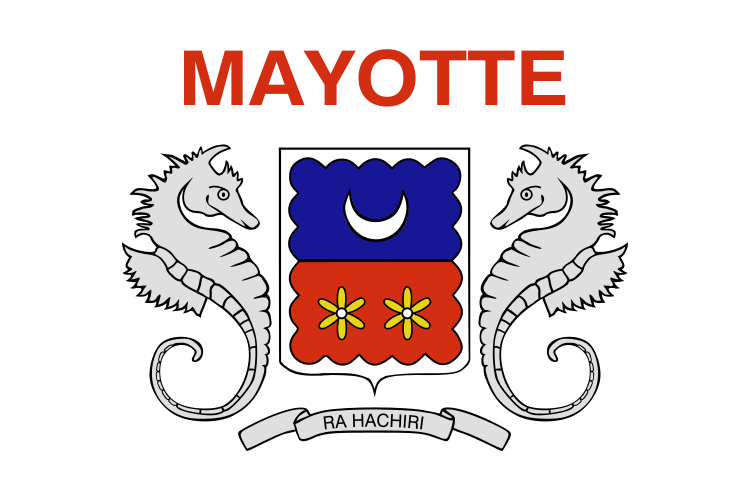
 Guía para expatriados a largo plazo · Mayotte
Guía para expatriados a largo plazo en Mayotte
Visados, vías de residencia, obligaciones fiscales y acceso a la sanidad para expatriados de larga duración
Guía para expatriados a largo plazo en Mayotte
Mayotte, as an overseas department and region of France, adheres to French immigration law, with specific adaptations for its unique context. All visa and residency matters are primarily managed by the French Ministry of Interior and locally by the Préfecture de Mayotte.
-
Visa-free entry and tourist stay limits:
- EU/EEA/Switzerland citizens: Can enter Mayotte with a valid ID card or passport and stay indefinitely. No visa is required.
- US, UK, Canadian, Australian, New Zealand citizens, and many other nationalities (Schengen Area visa-exempt countries): Can enter Mayotte visa-free for stays up to 90 days within any 180-day period for tourism or business purposes. A valid passport, valid for at least three months beyond the intended departure date, is required. This aligns with the Schengen Area rules, although Mayotte is not part of the Schengen Area itself, its visa policy largely mirrors it for short stays.
- For stays exceeding 90 days, a long-stay visa (Visa de Long Séjour – VLS) is mandatory, even for visa-exempt nationalities.
-
Temporary Residency Tracks:
- Work Visa (Visa de Long Séjour valant Titre de Séjour 'Salarié' or 'Travailleur Temporaire'): Requires a pre-approved employment contract from a Mayotte-based employer. The employer must initiate the work permit application (autorisation de travail) with the local Direction de l'Économie, de l'Emploi, du Travail et des Solidarités (DEETS) before the foreign national applies for a visa. Once approved, the visa application proceeds via the French consulate in the applicant's home country.
- Study Visa (VLS-TS 'Étudiant'): For individuals admitted to an educational institution in Mayotte. Requires proof of admission, sufficient financial resources (approximately €615/month or $665/month as of May 2026), and accommodation. Applications are made through Campus France (if applicable) and then the French consulate.
- Family Reunion Visa (VLS-TS 'Vie Privée et Familiale'): For spouses, minor children, or dependent ascendants of a French citizen or a foreign national legally residing in Mayotte. Specific conditions apply regarding the sponsor's residency status, income, and accommodation. The process often involves the Office Français de l'Immigration et de l'Intégration (OFII).
- Visitor Visa (VLS-TS 'Visiteur'): For individuals wishing to reside in Mayotte without working, provided they have sufficient financial means and health insurance. This is often used by retirees or those with independent income.
- Investment Visa: While no specific 'investment visa' exists solely for Mayotte, significant business investment or creation can facilitate a long-stay visa for business creators or entrepreneurs (VLS-TS 'Entrepreneur/Profession Libérale'). This requires a robust business plan and proof of funds.
-
Permanent Residency: After five years of continuous legal residency in France (including Mayotte) under certain long-stay permits, foreigners may be eligible to apply for a 'carte de résident' (permanent residency card), valid for 10 years and renewable. Eligibility criteria include integration into French society, sufficient resources, and adherence to republican values. The application is made at the Préfecture de Mayotte.
-
Citizenship: Foreigners can apply for French citizenship through naturalization after five years of continuous legal residency in France (including Mayotte). Reduced residency periods may apply for certain categories (e.g., two years for graduates of French higher education, one year for those rendering exceptional service). Marriage to a French citizen can also lead to citizenship after four years of marriage and cohabitation. Requirements include demonstrating French language proficiency (B1 level), knowledge of French history and culture, and adherence to French values. The process is lengthy, typically taking several years.
-
Work Permits and Employment Authorisation: For non-EU/EEA/Swiss citizens, a work permit (autorisation de travail) is mandatory. This is usually obtained by the employer on behalf of the prospective employee from the DEETS in Mayotte. The permit is tied to a specific job and employer. Self-employment requires a specific 'profession libérale' or 'commerçant' visa/residency permit.
-
Digital Nomad or Remote Worker Visa Programmes: As of May 2026, France (and by extension Mayotte) does not have a dedicated 'digital nomad' visa programme akin to those in some other countries. Remote workers would typically need to qualify under existing long-stay visa categories, such as the 'Visiteur' visa (if not working for a French entity and having sufficient independent income) or potentially an 'Entrepreneur/Profession Libérale' visa if establishing a freelance activity. The French government has been discussing potential reforms, but no specific digital nomad visa for 2025-2026 has been officially implemented for Mayotte.
-
Student Visas: The VLS-TS 'Étudiant' is the primary student visa. It allows students to work part-time (up to 964 hours per year) and is renewable annually if academic progress is satisfactory. After graduation, a 'carte de séjour recherche d'emploi/création d'entreprise' (job search/business creation permit) may be available for a limited period.
-
Family Reunion and Dependent Visas: These are typically VLS-TS 'Vie Privée et Familiale'. The primary applicant (sponsor) must hold a valid long-stay permit in Mayotte, meet income thresholds, and have suitable accommodation. The process is often initiated via OFII.
-
Application Process:
- Where to apply: Short-stay visas are applied for at French consulates or visa application centers in the applicant's country of residence. Long-stay visas (VLS-TS) are also applied for at French consulates. Upon arrival in Mayotte, holders of VLS-TS must validate their visa online via the OFII website within three months. For subsequent renewals or changes of status, applications are made at the Préfecture de Mayotte.
- Documentation: Generally includes a valid passport, visa application form, passport-sized photos, proof of accommodation, financial resources, health insurance, and specific documents related to the visa category (e.g., employment contract, university admission letter, marriage certificate). All non-French documents usually require official translation and apostille/legalization.
- Fees: Visa fees vary but are typically around €99 (approximately $107) for long-stay visas, payable in local currency at the consulate. Residency permit fees upon arrival or renewal can range from €200 to €260 (approximately $216 to $281), paid via tax stamps (timbres fiscaux).
- Timelines: Short-stay visas can take 2-15 working days. Long-stay visas can take 3 weeks to 3 months, depending on the consulate and complexity. Processing times for residency permits at the Préfecture can be several months.
-
Renewal Procedures: VLS-TS holders must apply for a 'carte de séjour' (residency permit) at the Préfecture de Mayotte 2-4 months before their current visa/permit expires. Required documents include proof of continued eligibility for the permit category, financial resources, accommodation, and health insurance.
-
Common Pitfalls and Refusal Reasons:
- Incomplete or incorrect documentation.
- Insufficient financial resources.
- Lack of comprehensive health insurance.
- Overstaying previous visas.
- Criminal record or security concerns.
- Failure to prove genuine intent (e.g., for tourism or study).
- Not validating the VLS-TS with OFII upon arrival.
It is highly recommended to consult the official websites of the French Ministry of Interior (interieur.gouv.fr), Service-Public.fr, and the Préfecture de Mayotte (prefecture.gouv.fr/mayotte) or the relevant French consulate for the most up-to-date and specific requirements.
As an overseas department of France, Mayotte's tax system is largely governed by French tax law, administered by the Direction Générale des Finances Publiques (DGFiP), with local specificities. All figures are approximate as of May 2026.
-
Tax Residency Rules: A foreigner generally becomes a tax resident of Mayotte (and thus France) if any of the following criteria are met:
- Their primary home or habitual abode is in Mayotte.
- Their main place of stay (more than 183 days in a calendar year) is in Mayotte.
- Their principal professional activity is in Mayotte.
- Their center of economic interests is in Mayotte. Tax residents are taxed on their worldwide income, while non-residents are only taxed on income sourced in France/Mayotte.
-
Income Tax Rates and Brackets (for residents): Income tax in Mayotte is progressive, similar to metropolitan France but with specific local adjustments. Taxable income is calculated after various deductions and allowances. For 2025 income (filed in 2026), the general income tax brackets for a single person are approximately:
- Up to €11,294 (approx. $12,200): 0%
- €11,295 to €28,797 (approx. $12,201 to $31,100): 11%
- €28,798 to €82,341 (approx. $31,101 to $89,000): 30%
- €82,342 to €177,106 (approx. $89,001 to $191,500): 41%
- Above €177,106 (approx. $191,500): 45% These rates are applied to 'parts' (tax units) based on family situation. Non-residents are subject to a minimum tax rate of 20% on French-sourced income, with certain exceptions.
-
Double Taxation Treaties: France has an extensive network of double taxation treaties with over 120 countries worldwide (e.g., US, UK, Canada, Germany, Italy, Spain, Switzerland). These treaties aim to prevent individuals from being taxed twice on the same income in both France (including Mayotte) and their home country. The specific provisions of each treaty determine which country has the right to tax certain types of income and provide mechanisms for relief from double taxation.
-
Social Security and Pension Contributions for Foreigners: All employed individuals in Mayotte (including foreigners) are generally required to contribute to the French social security system (Sécurité Sociale), managed locally by the Caisse Générale de Sécurité Sociale (CGSS) de Mayotte. Contributions cover healthcare, maternity, family benefits, work accidents, and pensions. Employer and employee contributions are mandatory and can be substantial, typically around 20-25% of gross salary for employees and 25-45% for employers. Self-employed individuals also contribute to a specific social security regime. Expats from countries with social security agreements with France (e.g., EU/EEA, Switzerland, US, Canada, UK in some cases) may be exempt from certain contributions or have their contributions recognized towards benefits in their home country.
-
Tax Filing Requirements, Deadlines, and How to File:
- Requirements: All tax residents of Mayotte must file an annual income tax return (déclaration de revenus). Non-residents with French-sourced income also have filing obligations.
- Deadlines: The filing deadline for income earned in year N (e.g., 2025 income) is typically in May or June of year N+1 (e.g., May/June 2026), with specific dates varying based on the department of residence and whether filing online or by paper. Online filing is mandatory for most taxpayers.
- How to file: Tax returns are filed online via the official DGFiP website (impots.gouv.fr). First-time filers may need to register to receive their tax number (numéro fiscal).
-
Tax Deductions and Allowances: Expats can benefit from various deductions and allowances, including those for dependent children, certain professional expenses, charitable donations, and investments in specific schemes. The 'quotient familial' system, which divides taxable income by the number of 'parts' in a household, significantly reduces the effective tax rate for families.
-
Property Ownership Tax for Foreigners: Foreigners owning property in Mayotte are subject to local property taxes:
- Taxe Foncière: An annual property tax based on the cadastral rental value of the property. Rates are set by local municipalities.
- Taxe d'Habitation: A residence tax, generally paid by the occupant (owner or tenant) of a property. However, this tax has been progressively phased out for primary residences and is largely abolished as of 2023, though it may still apply to secondary residences.
- Wealth Tax (Impôt sur la Fortune Immobilière - IFI): France has abolished its general wealth tax but introduced the IFI in 2018, which applies only to real estate assets exceeding €1.3 million (approximately $1.4 million). This applies to both residents and non-residents on their French real estate assets.
-
Capital Gains Tax: Capital gains from the sale of real estate in Mayotte are generally subject to income tax at a flat rate of 19% plus social levies (around 17.2%), totaling approximately 36.2%. Exemptions and reductions apply for primary residences and long-term ownership. Capital gains on movable assets (e.g., shares) are generally taxed at a flat rate of 30% (Prélèvement Forfaitaire Unique - PFU), which includes income tax and social levies.
-
VAT and Other Indirect Taxes:
- Value Added Tax (VAT - Taxe sur la Valeur Ajoutée - TVA): Mayotte benefits from specific reduced VAT rates compared to metropolitan France. The standard rate is 19%, with reduced rates of 2.1% (e.g., for certain press publications, medicines) and 5.5% (e.g., for certain food products, energy renovation work). These rates are lower than the metropolitan French rates.
- Other indirect taxes: Include excise duties on alcohol and tobacco, and a tax on financial transactions.
-
When to Engage a Local Tax Advisor: Given the complexities of French tax law and its specific adaptations for Mayotte, it is highly recommended for expats, especially those with complex income sources (e.g., self-employment, international investments, property ownership), to engage a local tax advisor or an accountant specializing in international taxation. This is particularly crucial upon arrival to understand tax residency implications and ensure compliance.
-
Penalties for Non-Compliance: Penalties for non-compliance can be severe, including late filing penalties (10% to 40% of tax due), interest on late payments (0.2% per month), and significant fines for under-declaration or fraud. Failure to declare foreign bank accounts or assets can also lead to heavy penalties.
Mayotte's healthcare system is part of the French national healthcare system (Sécurité Sociale), which is primarily public and funded through mandatory social security contributions. While it benefits from metropolitan French standards, Mayotte faces unique challenges due to its geographical isolation and rapid population growth, leading to a system that can be stretched.
-
Healthcare System Overview:
- Public vs. Private: The system is predominantly public, centered around the Centre Hospitalier de Mayotte (CHM) in Mamoudzou and several dispensaries/health centers across the island. There is a very limited private sector, mainly for specialized consultations or dental care.
- Funding: Funded primarily through mandatory social security contributions (cotisations sociales) from employers and employees, as well as government subsidies. This system covers a significant portion of healthcare costs.
-
Access Rights for Foreigners:
- Tourists: Should have comprehensive travel health insurance covering medical emergencies, repatriation, and hospitalization. They do not have access to the public system for routine care.
- Residents/Workers: Foreigners legally residing and working in Mayotte, or those with long-stay visas, are generally eligible to register with the public healthcare system (Assurance Maladie) through the Caisse Générale de Sécurité Sociale (CGSS) de Mayotte. Once registered, they receive a 'carte Vitale' (health insurance card) and are reimbursed for a portion of their medical expenses.
-
Health Insurance:
- Required: For long-term stays (over 3 months), comprehensive health insurance is mandatory. If you are employed or self-employed, you will contribute to and be covered by the public system.
- Public Coverage: The public system typically reimburses 70% of doctor's fees, 80% of hospital costs, and varying percentages for medications. The remaining portion, known as the 'ticket modérateur,' is the patient's responsibility. This gap is usually covered by a complementary private health insurance (mutuelle).
-
How to Register with the Public Healthcare System as a Foreigner:
- Obtain a Social Security Number: If employed, your employer will typically initiate this. If self-employed or a long-term resident not working, you apply directly to the CGSS de Mayotte. You'll need proof of identity, legal residency (visa/residency permit), proof of address, and potentially proof of income or employment.
- Apply for a 'Carte Vitale': Once registered and assigned a social security number, you can apply for your 'carte Vitale,' which electronically processes reimbursements. This can take several months to receive.
- Choose a 'Médecin Traitant': It is recommended to declare a 'médecin traitant' (referring doctor) to the CGSS to ensure better reimbursement rates and coordinated care.
-
Private Health Insurance (Mutuelle): Highly recommended for all residents, including expats, to cover the portion of medical costs not reimbursed by the public system. This 'mutuelle' acts as a top-up insurance. Typical costs for a basic mutuelle can range from €30-€100 (approximately $32-$108) per person per month, depending on age, coverage level, and provider. Recommended providers include French mutuelles like April International, Malakoff Humanis, or international providers with French coverage.
-
Quality of Public vs. Private Care:
- Public Care: The Centre Hospitalier de Mayotte (CHM) is the main public hospital, offering a range of services, including emergency care, surgery, and specialized departments. While it strives to meet French standards, resources can be strained, and complex cases may require medical evacuation to Reunion Island or metropolitan France. Waiting times for non-emergency appointments can be long.
- Private Care: The private sector is very limited. Some private practitioners (GPs, dentists, ophthalmologists) exist, often offering quicker appointments but at a higher cost, which is then partially reimbursed by the public system and your mutuelle.
-
Emergency Services:
- How to access: Dial 15 (SAMU - medical emergencies), 18 (Pompiers - fire and rescue, also for medical emergencies), or 112 (European emergency number). These services are available 24/7.
- What to expect: Emergency services are generally efficient for critical situations. Patients will be transported to the CHM. Be prepared for potential language barriers if you do not speak French.
-
Prescription Medications:
- Availability: Pharmacies are available in Mamoudzou and larger towns. Most common medications are available, but specialized or less common drugs might need to be ordered or sourced from Reunion Island.
- Cost: Medications prescribed by a doctor are partially reimbursed by the public health system (20% to 100%, depending on the drug's importance) and the remainder by your mutuelle. Over-the-counter medications are not reimbursed.
- How to obtain: A valid prescription from a doctor in Mayotte or France is required for most prescription medications.
-
Dental and Vision Care:
- Public Coverage: The public system offers limited reimbursement for routine dental check-ups, fillings, and basic vision care (e.g., standard frames and lenses). Significant out-of-pocket expenses are common for more complex dental work (e.g., orthodontics, implants) and higher-end optical products.
- Out-of-pocket: Many expats opt for a higher-tier mutuelle to cover a larger portion of dental and vision costs, as these can be expensive without additional coverage.
-
Mental Health Services: Mental health services are available through the public hospital (CHM) and some private practitioners. Access can be challenging due to limited specialists. Consultations with psychologists or psychiatrists are partially reimbursed by the public system and mutuelle if referred by a general practitioner.
-
Maternity Care and Childbirth Options: Mayotte offers comprehensive maternity care through the CHM. Prenatal care, childbirth, and postnatal care are covered by the public health system (100% from the 6th month of pregnancy). While facilities are modern, some high-risk pregnancies may be transferred to Reunion Island or metropolitan France due to specialized care needs. Expats should register their pregnancy with the CGSS and their chosen doctor early.
-
Vaccinations and Travel Health Requirements:
- Required: No specific vaccinations are legally required for entry to Mayotte from most countries, but a yellow fever vaccination certificate is required for travelers arriving from countries with a risk of yellow fever transmission.
- Recommended: Routine vaccinations (MMR, DTP, etc.) should be up-to-date. Vaccinations for Hepatitis A and B, Typhoid, and Rabies are often recommended, especially for long-term stays or those planning to travel to rural areas. Consult a travel health clinic before relocating.
- Mosquito-borne diseases: Dengue, Chikungunya, and Zika are endemic. Protection against mosquito bites is crucial. Malaria is not endemic but can be imported.
Más información para tu mudanza a Mayotte
Guías completas y análisis basados en datos.
Presupuesto y gastos
¿Es asequible tu estilo de vida? Desde precios de supermercado hasta facturas de servicios, ve cómo se comparan los costes.
Leer guíaColegios y familia
Encontrar el colegio adecuado es una prioridad. Compara colegios internacionales y estándares curriculares.
Leer guíaTransporte
¿Cómo te mueves? Cobertura de transporte público, aeropuertos y calidad de la infraestructura de un vistazo.
Leer guía