
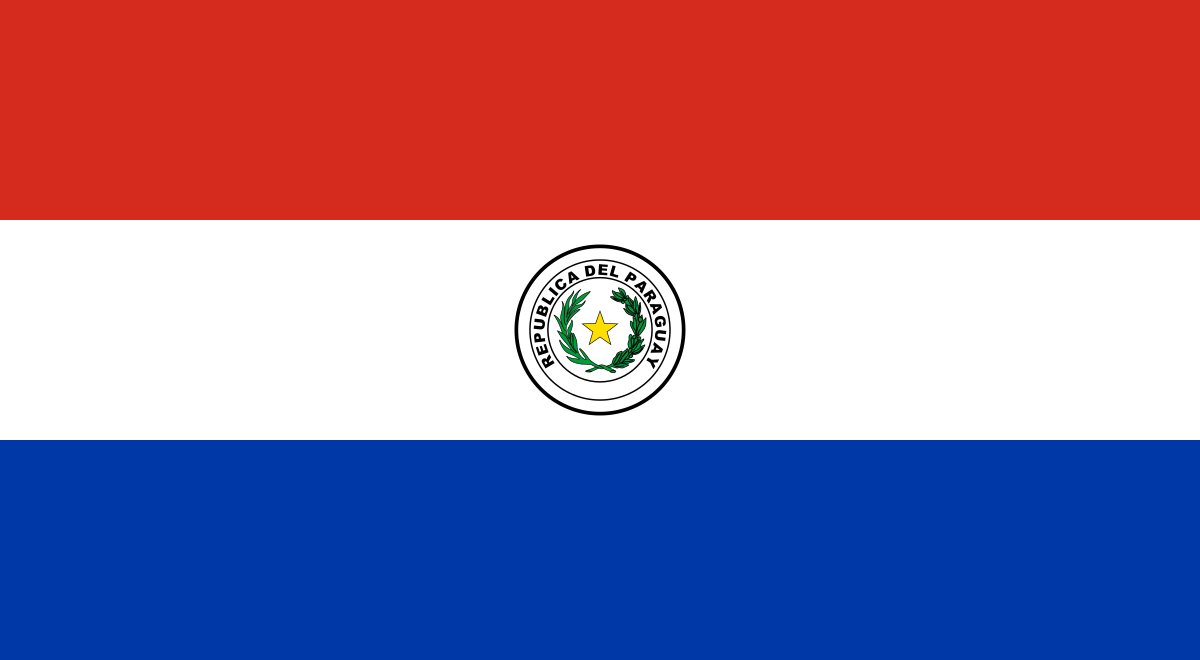
 Langzeit-Expat-Leitfaden · Paraguay
Langzeit-Expat-Leitfaden in Paraguay
Visa, Aufenthaltswege, Steuerpflichten und Zugang zum Gesundheitssystem für Langzeit-Expats
Langzeit-Expat-Leitfaden für Paraguay
Relocating to Paraguay requires a clear understanding of its immigration framework, which has seen some updates to streamline processes. The Dirección General de Migraciones (DGM) is the primary authority for all immigration matters.
-
Visa-Free Entry and Tourist Stay Limits:
- Citizens from Mercosur member and associated states (e.g., Argentina, Brazil, Uruguay, Chile, Bolivia, Peru, Ecuador, Colombia) generally enjoy visa-free entry for up to 90 days, often extendable.
- Passport holders from many countries, including the European Union, the United States, the United Kingdom, Canada, Australia, and New Zealand, can typically enter Paraguay visa-free for tourism purposes for up to 90 days. This stay can usually be extended once for another 90 days by applying to the DGM before the initial period expires. Overstaying can result in significant fines.
-
Temporary Residency Tracks: Temporary residency is the initial step for most long-term expats and is typically granted for one or two years, renewable.
- Work Visa/Residency: Requires an employment contract with a Paraguayan company, which acts as a sponsor. The employer must demonstrate the need for a foreign worker. Documentation includes the contract, company registration, and the applicant's qualifications.
- Study Visa/Residency: For individuals enrolled in accredited educational institutions in Paraguay. Requires an acceptance letter, proof of financial solvency, and a clean criminal record.
- Family Reunion Visa/Residency: Available for spouses, minor children, or dependent parents of Paraguayan citizens or permanent residents. Requires proof of relationship (marriage certificate, birth certificate) and the sponsor's financial capacity.
- Investment Visa/Residency: This is a popular route. While specific investment amounts can vary, a common path involves demonstrating a significant investment in a Paraguayan company, real estate, or agricultural project. The investment must be registered with the relevant authorities. This category often leads directly to permanent residency.
- Rentista/Retiree Visa/Residency: For individuals who can demonstrate a stable, sufficient income from abroad (e.g., pensions, investments) to support themselves without working in Paraguay. The required income threshold is subject to DGM review.
-
Permanent Residency:
- Eligibility: After holding temporary residency for a specified period (often two years), or directly for certain categories like significant investors or retirees with substantial passive income. Key requirements include a clean criminal record from both Paraguay and the applicant's home country, proof of financial solvency, and a medical certificate.
- Timeline: The processing time for permanent residency can range from 6 months to 2 years, depending on the category and completeness of documentation. As of April 2026, the DGM has been working to digitize and expedite some processes, but patience is still advised.
- Process: Involves submitting a comprehensive set of documents to the DGM, including authenticated copies of personal documents, police clearances, medical certificates, and proof of financial means. An interview may be required.
-
Citizenship:
- Requirements: Foreigners can apply for naturalization after a minimum of three consecutive years of permanent residency in Paraguay. Applicants must demonstrate good conduct, sufficient integration into Paraguayan society, and a basic knowledge of Spanish and/or Guaraní, as well as Paraguayan history and geography. Renunciation of previous citizenship is generally not required, as Paraguay permits dual nationality.
- Timeline: The naturalization process is lengthy and can take several years after meeting the residency requirement, involving judicial and administrative steps.
-
Work Permits and Employment Authorisation: A work permit is intrinsically linked to a temporary residency visa obtained through an employment contract. Foreigners cannot legally work in Paraguay on a tourist visa. The employer is responsible for initiating the process and ensuring compliance with labor laws.
-
Digital Nomad or Remote Worker Visa Programmes: As of April 2026, Paraguay does not have a specific, dedicated digital nomad visa program similar to those found in many other countries. Remote workers wishing to reside in Paraguay typically apply for temporary residency under categories such as 'Rentista' (proving sufficient passive income from abroad) or by establishing a local business entity. It is crucial for remote workers to consult with a local immigration lawyer to determine the most appropriate and compliant residency pathway.
-
Student Visas: As covered under temporary residency, these are for individuals pursuing education. They require an acceptance letter from a recognized Paraguayan educational institution, proof of financial support, and a police clearance certificate.
-
Family Reunion and Dependent Visas: Also covered under temporary residency, these allow family members (spouses, children, dependent parents) of Paraguayan citizens or residents to obtain residency. The process requires proof of relationship and the primary applicant's ability to support dependents.
-
Application Process:
- Where to Apply: Applications for residency are typically submitted in person at the Dirección General de Migraciones (DGM) headquarters in Asunción or its regional offices. For initial visas, applications may be made at a Paraguayan embassy or consulate in the applicant's home country, though many residency processes are initiated from within Paraguay after entering as a tourist.
- Documentation: Generally includes a valid passport, birth certificate, marriage certificate (if applicable), police clearance certificates from the home country and Paraguay, medical certificate, proof of financial solvency, and specific documents related to the chosen residency category (e.g., employment contract, investment proof, university acceptance letter). All foreign documents must be apostilled or legalized by a Paraguayan consulate and translated into Spanish by a certified public translator in Paraguay.
- Fees: Application fees vary significantly by visa/residency type. For temporary residency, expect fees in the range of PYG 1,500,000 to PYG 3,000,000 (approximately USD 200-400 as of April 2026). Permanent residency fees can be higher. There are also costs for document authentication, translations, and legal assistance.
- Timelines: Processing times can vary widely, from a few months for straightforward temporary residencies to over a year for permanent residency or complex cases. It's advisable to start the process well in advance.
-
Renewal Procedures: Temporary residency permits must be renewed before their expiry date. The renewal process involves submitting updated documentation, including proof of continued eligibility (e.g., ongoing employment, enrollment, financial means) and a clean police record. Permanent residency generally does not require renewal but may require periodic re-entry to Paraguay or proof of continued ties to maintain its validity.
-
Common Pitfalls and Refusal Reasons:
- Incomplete or Incorrect Documentation: This is the most frequent cause of delays or refusals. Ensure all documents are correctly apostilled/legalized and translated.
- Criminal Record: Applicants with serious criminal records will likely be refused.
- Insufficient Financial Means: Failure to demonstrate adequate financial support for the applicant and dependents.
- Overstaying Tourist Visa: Applying for residency after overstaying a tourist visa can lead to fines and complications.
- Misrepresentation: Providing false information or fraudulent documents will lead to immediate refusal and potential legal consequences.
- Lack of Legal Assistance: Navigating the Paraguayan immigration system can be complex; engaging a local immigration lawyer is highly recommended to avoid common errors.
Paraguay operates a territorial tax system, meaning that generally, only income generated within Paraguay is subject to Paraguayan taxation. This is a significant advantage for expats with foreign-sourced income. The Subsecretaría de Estado de Tributación (SET) is the national tax authority.
-
Tax Residency Rules: A foreigner becomes a tax resident in Paraguay if they spend more than 120 days in the country within a calendar year. Alternatively, an individual may be considered a tax resident if their 'center of vital interests' (e.g., family, primary economic activities) is in Paraguay, even if they spend less than 120 days.
-
Income Tax Rates and Brackets for Residents vs. Non-Residents:
- Residents (Impuesto a la Renta Personal - IRP): Tax residents are subject to Personal Income Tax (IRP) on their Paraguayan-sourced income. The IRP system is progressive:
- Income up to 50,000,000 PYG (approx. USD 6,750 as of April 2026) is taxed at 8%.
- Income exceeding 50,000,000 PYG is taxed at 10%.
- Note: Foreign-sourced income is generally exempt from IRP for tax residents under the territorial tax system.
- Non-Residents: Non-residents are taxed at a flat rate of 15% on their Paraguayan-sourced income, typically withheld at source.
- Residents (Impuesto a la Renta Personal - IRP): Tax residents are subject to Personal Income Tax (IRP) on their Paraguayan-sourced income. The IRP system is progressive:
-
Double Taxation Treaties: Paraguay has a limited number of double taxation treaties (DTTs) compared to many other countries. Key countries with active DTTs include:
- Argentina
- Brazil
- Chile
- Uruguay
- Spain These treaties aim to prevent individuals and companies from being taxed twice on the same income in both countries. It's crucial to consult the specific treaty relevant to your situation.
-
Social Security and Pension Contributions for Foreigners:
- Instituto de Previsión Social (IPS): Formal employees in Paraguay, including foreigners, are generally required to contribute to the IPS, the national social security system. Contributions cover health, maternity, and pension benefits.
- Contribution Rates (as of April 2026):
- Employee: 9% of gross salary.
- Employer: 16.5% of gross salary.
- Self-employed individuals can voluntarily opt into the IPS system. Contributions are mandatory for those employed under a Paraguayan contract.
-
Tax Filing Requirements, Deadlines, and How to File:
- Requirements: Tax residents with taxable Paraguayan-sourced income exceeding the minimum threshold (currently around 120 minimum monthly wages, subject to annual adjustment) must file an annual IRP declaration.
- Deadlines: The annual tax filing deadline for IRP is typically in March or April of the following year for the previous tax year. Specific dates are published by SET annually.
- How to File: Tax declarations are primarily filed electronically through the SET's online portal using a taxpayer identification number (RUC - Registro Único de Contribuyentes).
-
Tax Deductions and Allowances Available to Expats: Expats who are tax residents can claim certain deductions against their Paraguayan-sourced income for IRP purposes. These typically include:
- Expenses related to education, health, and rent within Paraguay.
- Contributions to local pension funds.
- Certain investments in the local economy.
- It's important that these expenses are properly documented and related to income generated in Paraguay.
-
Property Ownership Tax for Foreigners (Impuesto Inmobiliario): Foreigners owning property in Paraguay are subject to annual municipal property tax (Impuesto Inmobiliario). The rate varies by municipality and property type (urban vs. rural) but generally ranges from 0.5% to 1% of the cadastral value of the property.
-
Capital Gains Tax: Capital gains derived from the sale of assets located in Paraguay (e.g., real estate, shares in Paraguayan companies) are generally subject to IRP for individuals or corporate income tax for companies. Specific rates may apply to certain transactions, such as a 10% tax on capital gains from the sale of real estate.
-
VAT and Other Indirect Taxes Affecting Daily Life:
- Value Added Tax (IVA): The standard VAT rate in Paraguay is 10%. A reduced rate of 5% applies to certain essential goods and services, such as basic foodstuffs, pharmaceuticals, and some agricultural products. VAT is included in the price of most goods and services.
- Selective Consumption Tax (ISC): Applies to specific luxury goods, tobacco, alcoholic beverages, and fuels.
-
Wealth or Net Worth Taxes: Paraguay does not impose a wealth or net worth tax on individuals or corporations.
-
When to Engage a Local Tax Advisor: It is highly recommended to engage a local tax advisor or accountant upon arrival in Paraguay, especially if you have complex income streams, plan to invest, or operate a business. A local expert can provide tailored advice on:
- Determining your tax residency status.
- Understanding the nuances of the territorial tax system.
- Ensuring compliance with local filing requirements and deadlines.
- Optimizing tax planning strategies.
- Navigating any double taxation treaty implications.
-
Penalties for Non-Compliance: The SET imposes penalties for non-compliance, which can include:
- Fines: For late filing, incorrect declarations, or failure to file.
- Interest: On overdue tax payments.
- Surcharges: For underpayment or evasion.
- Serious non-compliance can lead to legal action and significant financial penalties.
Paraguay's healthcare system is structured into public, social security, and private sectors. While public healthcare is accessible, expats often opt for private services due to quality and availability, especially in major urban centers like Asunción and Ciudad del Este.
-
Healthcare System Overview: Public vs. Private, How it is Funded:
- Public Healthcare (Ministerio de Salud Pública y Bienestar Social - MSPyBS): This system provides free or low-cost basic medical services to all residents, including foreigners, through a network of hospitals and health centers. It is funded by the national government. However, public facilities, particularly outside major cities, can suffer from underfunding, long wait times, and limited resources.
- Social Security Healthcare (Instituto de Previsión Social - IPS): This system is funded by mandatory contributions from formally employed individuals and their employers. It provides comprehensive medical, maternity, and pension benefits to contributors and their dependents. IPS hospitals and clinics generally offer a higher standard of care than the general public system, but can still experience overcrowding.
- Private Healthcare: This sector comprises modern hospitals, clinics, and specialist practices, primarily concentrated in Asunción and Ciudad del Este. It is funded through private health insurance or out-of-pocket payments. Private facilities offer high-quality care, advanced equipment, shorter wait times, and often English-speaking staff, comparable to Western standards.
-
Access Rights for Foreigners (Tourists vs. Residents vs. Workers):
- Tourists: Can access public emergency services, though they may be charged for treatment. Private health insurance is strongly recommended for all tourists.
- Residents: All residents, including foreigners, can access the public MSPyBS system. However, for non-emergency care, costs may be incurred, and quality can be inconsistent.
- Workers: Foreigners formally employed in Paraguay and contributing to IPS have full access to the IPS healthcare system for themselves and their registered dependents.
-
Health Insurance: What is Required, What Public Coverage Covers:
- Required: While not legally mandatory for all foreigners to have private health insurance, it is highly recommended. For formally employed expats, contributions to IPS are mandatory, providing social security coverage.
- Public Coverage (MSPyBS): Covers basic medical consultations, emergency care, some hospitalizations, and limited medications. Quality and availability vary widely.
- IPS Coverage: For contributors, IPS covers general medical care, specialist consultations, hospitalization, surgeries, maternity care, and a range of prescription medications. It's a more comprehensive option than the general public system.
-
How to Register with the Public Healthcare System as a Foreigner:
- MSPyBS: There isn't a formal 'registration' process akin to some European systems. Foreigners can generally access public health centers by presenting their identification (passport or residency card). For ongoing care, a medical record will be created.
- IPS: Registration is automatic for formally employed individuals. Your employer will handle the enrollment process, and you will receive an IPS card that grants access to their network of facilities.
-
Private Health Insurance: Recommended Providers, Typical Costs:
- Recommended Providers: Both local and international options are available. Reputable local providers include Aseguradora Tajy, Sancor Seguros, and La Consolidada. International providers popular with expats include Cigna Global, Bupa Global, and Aetna International, offering more comprehensive global coverage.
- Typical Costs: Private health insurance costs vary significantly based on age, coverage level, and provider. For a healthy individual, monthly premiums can range from USD 50 to USD 200+ (approx. PYG 370,000 - PYG 1,480,000 as of April 2026) for local plans, and considerably more for international plans offering global coverage.
-
Quality of Public vs. Private Care in Practice:
- Public Care: Can be basic, with limited resources, long waiting times, and older infrastructure, especially outside Asunción. While emergency care is provided, non-urgent treatments might be delayed.
- Private Care: Offers a significantly higher standard, with modern facilities, advanced medical technology, well-trained staff (often with international experience), and a more patient-centric approach. For serious conditions or specialized treatments, private hospitals are the preferred choice for expats.
-
Emergency Services: How to Access, What to Expect:
- Emergency Number: The general emergency number in Paraguay is 911. This connects to police, fire, and ambulance services.
- Ambulance Services: Public ambulances are available but response times can be slow, particularly in rural areas. Private hospitals often operate their own ambulance services, which are generally more reliable and quicker for those with private insurance or the ability to pay.
- What to Expect: In public hospitals, expect basic facilities and potentially long waits. In private hospitals, you will receive prompt and high-quality care, but be prepared to show proof of insurance or payment upfront.
-
Prescription Medications: Availability, Cost, How to Obtain:
- Availability: Pharmacies (farmacias) are widespread, especially in urban areas. Many common medications are readily available, often without a prescription for drugs that would require one in other countries.
- Cost: Prescription medications are generally more affordable than in North America or Europe. Prices can vary between pharmacies.
- How to Obtain: For most common medications, you can simply purchase them over the counter. For controlled substances or specialized treatments, a doctor's prescription from a Paraguayan physician will be required.
-
Dental and Vision Care: Public Coverage vs. Out-of-Pocket:
- Public Coverage: The MSPyBS offers very limited basic dental care. IPS provides some basic dental services for its contributors.
- Out-of-Pocket/Private: For comprehensive dental and vision care, expats typically rely on private clinics. These facilities offer a full range of services, from routine check-ups to specialized treatments, at competitive prices compared to many Western countries. Private health insurance plans may offer partial coverage for these services.
-
Mental Health Services Available to Expats: Mental health services are developing in Paraguay. In major cities like Asunción, you can find private psychologists, psychiatrists, and therapists, some of whom offer services in English. Public mental health services are limited and may not meet the needs of expats. Private health insurance often includes some coverage for mental health consultations.
-
Maternity Care and Childbirth Options:
- Public/IPS: Public hospitals and IPS facilities offer maternity care and childbirth services. While generally safe, the facilities and level of personalized care may be basic.
- Private: Private hospitals provide excellent maternity care, with modern birthing suites, private rooms, and a range of options for childbirth (e.g., natural birth, C-section). Many expats prefer private hospitals for their comfort and higher standard of care.
-
Vaccinations and Travel Health Requirements:
- Routine Vaccinations: Ensure all routine vaccinations (MMR, DPT, Polio, etc.) are up to date.
- Recommended Vaccinations: Typhoid, Hepatitis A, and Hepatitis B are generally recommended. Depending on travel plans within Paraguay, Yellow Fever vaccination may be advised, especially if visiting rural or forested areas, though it's not typically required for entry unless arriving from an endemic country. Always consult with a travel health clinic or your doctor several weeks before traveling to Paraguay for personalized advice.
Mehr Einblicke für deinen Umzug nach Paraguay
Umfassende Ratgeber und datengetriebene Analysen.
Budget & Ausgaben
Ist dein Lebensstil erschwinglich? Von Lebensmittelpreisen bis zu Nebenkosten – sieh, wie die Kosten im Vergleich zu deiner Heimat sind.
Ratgeber lesenSchulen & Familie
Die richtige Schule zu finden hat Priorität. Vergleiche internationale Schulen und Lehrplanstandards.
Ratgeber lesenVerkehr & Transport
Wie kommt man voran? ÖPNV-Abdeckung, Flughäfen und Infrastrukturqualität auf einen Blick.
Ratgeber lesen