
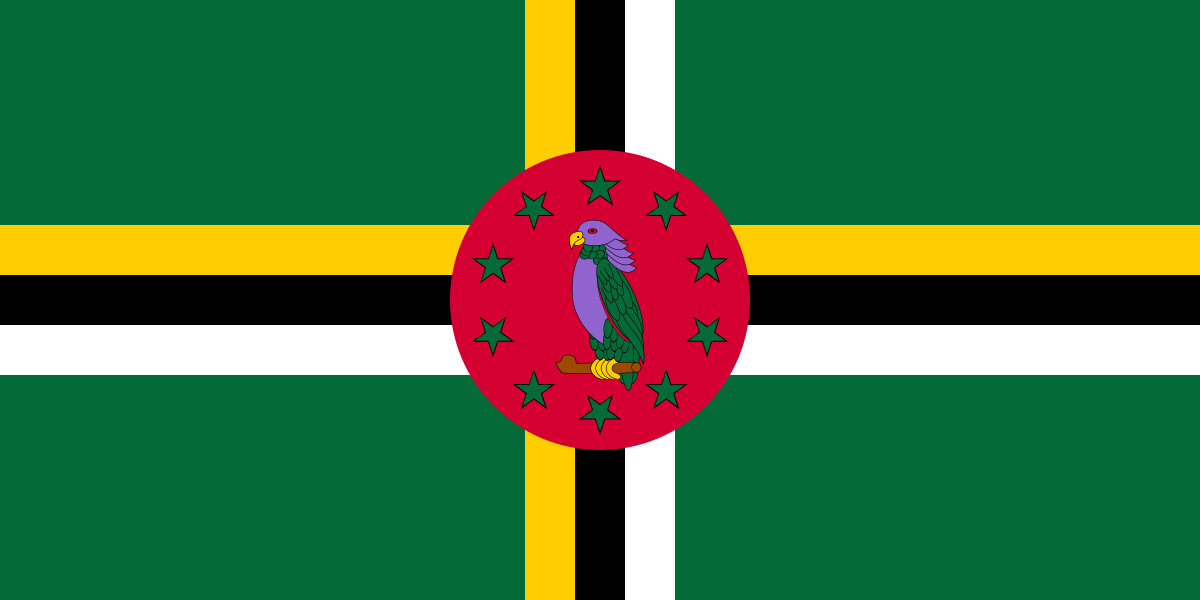
 Guide de l'expatrié à long terme · Dominica
Guide de l'expatrié à long terme en Dominica
Visas, voies de résidence, obligations fiscales et accès aux soins de santé pour les expatriés de longue durée
Guide de l'expatrié à long terme pour Dominica
Relocating to Dominica requires a thorough understanding of its immigration policies. The country is known for its welcoming stance, particularly through its Citizenship by Investment (CBI) program, but other pathways exist for temporary and permanent residency.
-
Visa-Free Entry and Tourist Stay Limits:
- Citizens of many countries, including the European Union (EU) member states, the United States (US), the United Kingdom (UK), Canada, and numerous Commonwealth countries, generally enjoy visa-free entry to Dominica for tourist purposes. The typical permitted stay is up to 6 months. Visitors must hold a valid passport, a return or onward ticket, and sufficient funds for their stay. Extensions may be possible through the Immigration Department.
-
Temporary Residency Tracks:
- Work Permits: Foreigners intending to work in Dominica must obtain a work permit. This typically requires a job offer from a Dominican employer who must demonstrate that no qualified Dominican national is available for the position. The application is usually initiated by the employer through the Ministry of National Security and Home Affairs. Required documents include a valid passport, police record, medical certificate, academic/professional qualifications, and a letter from the employer. Work permits are usually issued for one year and are renewable.
- Study Visas: Individuals accepted into educational institutions in Dominica can apply for a student visa. This requires proof of acceptance, financial means to cover tuition and living expenses, and a valid passport. Applications are made through the Immigration Department.
- Family Reunion: Spouses and dependent children of Dominican citizens or legal residents may apply for residency based on family ties. This involves proving the relationship and the sponsor's ability to support the dependents.
- Investment: The Dominica Citizenship by Investment (CBI) Programme is a direct route to citizenship, which inherently grants residency rights. It requires a significant investment in the country's economy, either through a contribution to the Economic Diversification Fund (EDF) or an investment in approved real estate projects. This program is a primary driver for long-term expats seeking immediate and comprehensive rights.
-
Permanent Residency:
- Dominica does not have a distinct 'permanent residency' status in the same way many other countries do. Instead, long-term residents typically transition from temporary permits to citizenship, especially through the CBI program or after a prolonged period of legal residency (e.g., 7 years for naturalization, though this is less common for expats than CBI).
-
Citizenship:
- Citizenship by Investment (CBI): This is the most direct and popular route for foreigners. As of April 2026, the program offers two main investment options:
- Economic Diversification Fund (EDF) Contribution: A non-refundable contribution starting from USD 100,000 for a single applicant, with additional fees for dependents.
- Real Estate Investment: Purchase of approved real estate with a minimum value of USD 200,000, which must be held for a specified period (typically 3-5 years). Additional government fees apply.
- Timeline: The CBI application process typically takes 3-6 months from submission to approval in principle, followed by the issuance of the Certificate of Naturalisation. Due diligence is a critical component.
- Naturalization: For those not pursuing CBI, naturalization may be possible after a significant period of legal residency (e.g., 7 years), demonstrating integration into Dominican society, and meeting other criteria. This path is generally more complex and lengthy for expats.
- Citizenship by Investment (CBI): This is the most direct and popular route for foreigners. As of April 2026, the program offers two main investment options:
-
Work Permits and Employment Authorisation:
- As mentioned, a work permit is mandatory for any foreigner seeking employment. The application is made to the Ministry of National Security and Home Affairs. It requires a formal job offer, proof of qualifications, and a police certificate. Self-employment also requires specific authorization.
-
Digital Nomad or Remote Worker Visa Programmes:
- Dominica launched its 'Work in Nature' (WIN) visa programme in 2020, targeting digital nomads and remote workers. This program is still active as of April 2026. It allows individuals to live and work remotely from Dominica for up to 18 months. Key requirements include:
- Proof of employment or self-employment outside Dominica.
- Minimum annual income of USD 50,000 (or equivalent).
- Valid passport and clean criminal record.
- Health insurance.
- Application Process: Applications are submitted online through the official 'Work in Nature' portal. Fees are typically USD 800 for a single applicant and USD 1,200 for a family. Processing usually takes a few weeks.
- Dominica launched its 'Work in Nature' (WIN) visa programme in 2020, targeting digital nomads and remote workers. This program is still active as of April 2026. It allows individuals to live and work remotely from Dominica for up to 18 months. Key requirements include:
-
Student Visas:
- For enrollment in Dominican educational institutions, a student visa is required. Applicants must provide an acceptance letter from a recognized institution, proof of financial stability, and a valid passport. The Immigration Department processes these applications.
-
Family Reunion and Dependent Visas:
- Spouses and minor children of individuals holding work permits, student visas, or CBI citizenship can apply for dependent status. The primary applicant must demonstrate the ability to financially support their dependents. Documentation proving family ties (marriage certificates, birth certificates) is essential.
-
Application Process (General):
- Where to Apply: For most visas and permits, applications are submitted to the Immigration Department within the Ministry of National Security and Home Affairs in Roseau. CBI applications are handled by the Citizenship by Investment Unit (CBIU).
- Documentation: Generally includes a valid passport, application forms, passport-sized photos, police certificate (good conduct certificate), medical examination results, proof of financial means, and specific documents related to the visa category (e.g., job offer, acceptance letter, investment proof).
- Fees: Vary significantly by visa type. Tourist visa extensions are minimal. Work permits can range from XCD 1,000 to XCD 5,000+ (approx. USD 370 to USD 1,850+) depending on the profession and duration. CBI fees are substantial, as noted above.
- Timelines: Tourist extensions are often quick (days to a week). Work permits can take several weeks. CBI is typically 3-6 months. Digital nomad visas usually process within 2-4 weeks.
-
Renewal Procedures:
- Most temporary permits (work, student, digital nomad) are issued for a specific duration and require renewal before expiration. The process generally involves submitting a new application form, updated supporting documents (e.g., continued employment, enrollment), and paying the applicable fees. It's crucial to apply for renewal well in advance of the expiry date.
-
Common Pitfalls and Refusal Reasons:
- Incomplete Documentation: The most common reason for delays or refusals. Ensure all required documents are provided and correctly filled out.
- Criminal Record: Applicants with serious criminal records are likely to be denied.
- Insufficient Funds: Failure to demonstrate adequate financial means for self-support or to meet investment requirements.
- Misrepresentation: Providing false or misleading information will lead to immediate refusal and potential bans.
- Overstaying Previous Visas: A history of violating immigration laws in Dominica or other countries can negatively impact future applications.
- Lack of Genuine Intent: For specific visas (e.g., student), not genuinely intending to pursue the stated purpose.
It is highly recommended to consult the official website of the Dominica Immigration Department or the Citizenship by Investment Unit (CBIU) for the most up-to-date requirements and to consider engaging a local immigration attorney or authorized CBI agent for complex applications.
Understanding Dominica's tax system is crucial for long-term expats. The country offers a relatively straightforward tax regime, but specific rules apply to residents and non-residents.
-
Tax Residency Rules:
- A foreigner generally becomes a tax resident in Dominica if they are physically present in the country for more than 183 days in a tax year (which aligns with the calendar year, January 1st to December 31st). Tax residency can also be established if an individual's 'centre of vital interests' is deemed to be in Dominica, even with shorter physical presence, though the 183-day rule is the primary determinant.
- Tax residents are generally taxed on their worldwide income, while non-residents are typically taxed only on income sourced within Dominica.
-
Income Tax Rates and Brackets for Residents vs. Non-Residents (as of April 2026):
- Dominica operates a progressive income tax system for individuals.
- Resident Individuals:
- First XCD 30,000 (approx. USD 11,100) of chargeable income: 0%
- Next XCD 20,000 (approx. USD 7,400): 15%
- Next XCD 30,000 (approx. USD 11,100): 25%
- Above XCD 80,000 (approx. USD 29,600): 35%
- Non-Resident Individuals: Generally taxed at a flat rate of 15% on income sourced in Dominica, such as rental income, professional fees, or interest, unless a double taxation treaty specifies otherwise. Employment income for non-residents working in Dominica is subject to the same progressive rates as residents.
-
Double Taxation Treaties (DTTs):
- Dominica has a limited number of active Double Taxation Treaties. Key countries with active DTTs include the United Kingdom and CARICOM member states. These treaties aim to prevent individuals and companies from being taxed twice on the same income in both Dominica and the treaty partner country. They often specify which country has the primary right to tax certain types of income and provide mechanisms for relief from double taxation.
-
Social Security and Pension Contributions for Foreigners:
- Foreigners employed in Dominica are generally required to contribute to the Dominica Social Security (DSS) scheme. Contributions are typically shared between the employer and employee.
- Employee Contribution: As of April 2026, employees contribute 5% of their insurable earnings.
- Employer Contribution: Employers contribute 6.5% of the employee's insurable earnings.
- The maximum insurable earnings limit is subject to periodic review. Contributions provide benefits such as sickness, maternity, injury, invalidity, and old-age pensions. Expats who contribute may be eligible for pro-rata benefits or a refund of contributions upon leaving, depending on the duration of contributions and their home country's social security agreements.
-
Tax Filing Requirements, Deadlines, and How to File:
- The tax year in Dominica is the calendar year (January 1st to December 31st).
- Deadline: Individual income tax returns must be filed by April 30th of the following year. For example, income earned in 2025 must be filed by April 30th, 2026.
- How to File: Tax returns are filed with the Inland Revenue Division (IRD) of the Ministry of Finance. Filing can be done manually by submitting forms to the IRD office or, increasingly, through online portals if available and adopted by the IRD.
- Employers are responsible for deducting Pay As You Earn (PAYE) income tax from employee salaries and remitting it to the IRD monthly.
-
Tax Deductions and Allowances Available to Expats:
- Residents are entitled to certain personal allowances and deductions, which can reduce their taxable income. These may include:
- Personal Allowance: A basic allowance for the individual taxpayer.
- Dependent Allowances: For spouses and children, subject to conditions.
- Mortgage Interest Relief: On interest paid for owner-occupied property.
- Life Insurance Premiums: Up to a certain limit.
- Approved Charitable Donations.
- Specific amounts for these allowances are set by the government and can change annually. Expats should consult the IRD for the most current figures.
- Residents are entitled to certain personal allowances and deductions, which can reduce their taxable income. These may include:
-
Property Ownership Tax for Foreigners:
- Foreigners owning property in Dominica are subject to Property Tax (Land and House Tax). This is an annual tax levied by the local government authorities (often the Roseau City Council or other village councils) based on the assessed value of the property.
- The rates vary depending on the location and type of property but are generally low compared to many Western countries. There are also stamp duties and transfer fees associated with property purchase, which apply to both locals and foreigners.
-
Capital Gains Tax:
- Dominica does not levy a general capital gains tax on individuals. This means profits from the sale of property, shares, or other assets are generally not subject to income tax. However, if an individual is deemed to be trading in such assets as a business, the profits may be considered business income and subject to income tax.
-
VAT and Other Indirect Taxes Affecting Daily Life:
- Value Added Tax (VAT): Dominica imposes VAT on most goods and services. The standard VAT rate is 15%. A reduced rate of 10% applies to hotel accommodation and diving services. Certain essential goods and services are zero-rated or exempt.
- Environmental Surcharge: A small fee may be applied to certain imported goods.
- Import Duties: Applied to imported goods, varying by product category.
- Hotel Accommodation Tax: In addition to VAT, a specific tax on hotel stays may apply.
-
Wealth or Net Worth Taxes:
- Dominica does not have wealth or net worth taxes on individuals.
-
When to Engage a Local Tax Advisor:
- It is highly advisable for expats, especially those with complex financial situations, multiple income streams, or those considering significant investments, to engage a local tax advisor. A professional can provide tailored advice on tax residency, optimize tax planning, ensure compliance with local laws, and navigate any specific treaty provisions. This is particularly important when first establishing tax residency or if you are self-employed.
-
Penalties for Non-Compliance:
- Failure to file tax returns on time or to pay taxes due can result in penalties, including fines and interest charges on overdue amounts. Deliberate tax evasion can lead to more severe legal consequences.
Dominica's healthcare system is undergoing continuous development, with efforts to improve facilities and services. Expats should be aware of the distinctions between public and private care and plan their health insurance accordingly.
-
Healthcare System Overview: Public vs. Private, How it is Funded:
- Dominica operates a two-tiered healthcare system comprising public and private facilities.
- Public Healthcare: This system is primarily funded by the government through general taxation and contributions to the Dominica Social Security (DSS) scheme. It includes district clinics, health centers, and two main hospitals: the Dominica-China Friendship Hospital (formerly Princess Margaret Hospital) in Roseau and the Regency Medical Centre in Portsmouth. Public healthcare aims to provide basic medical services to all citizens and legal residents.
- Private Healthcare: A smaller private sector exists, offering more personalized care, shorter waiting times, and sometimes access to a wider range of specialists or diagnostic equipment. Private clinics and a few private practitioners operate, mainly in Roseau.
-
Access Rights for Foreigners (Tourists vs. Residents vs. Workers):
- Tourists: Can access public healthcare facilities for emergencies, but will be charged for services. Travel insurance with comprehensive medical coverage is essential.
- Legal Residents/Workers: Foreigners who are legal residents and contribute to the Dominica Social Security (DSS) scheme may have access to public healthcare services, often at subsidized rates or for free for basic care. However, the extent of coverage can vary, and many still opt for private insurance.
- Citizenship by Investment (CBI) Citizens: As citizens, they have the same access rights to public healthcare as native Dominicans, though the quality and scope of public services often lead them to prefer private options or seek treatment abroad for complex conditions.
-
Health Insurance: What is Required, What Public Coverage Covers:
- Required: While not legally mandated for all foreigners, comprehensive health insurance is highly recommended for all expats. For specific visa programs like the 'Work in Nature' (WIN) digital nomad visa, health insurance is a mandatory requirement.
- Public Coverage: For those eligible (e.g., DSS contributors), public healthcare covers basic consultations, some medications, and emergency care. However, it may not cover specialist consultations, advanced diagnostics, or elective procedures, and waiting times can be significant. The scope of public coverage is generally limited compared to Western standards.
-
How to Register with the Public Healthcare System as a Foreigner:
- Foreigners who are legally employed and contributing to the Dominica Social Security (DSS) scheme are automatically part of the social security system, which includes some health benefits. There isn't a separate 'registration' process for public healthcare beyond DSS enrollment. For direct access to public clinics, presenting proof of residency and ID is usually sufficient, but charges may apply depending on the service and your status.
-
Private Health Insurance: Recommended Providers, Typical Costs:
- Recommended Providers: Many expats opt for international health insurance providers that offer worldwide coverage, including in Dominica. Reputable providers include Cigna Global, Allianz Care, Bupa Global, and GeoBlue. Local insurance options are also available, but international plans often provide more comprehensive coverage and options for medical evacuation.
- Typical Costs: Private health insurance costs vary widely based on age, coverage level, deductible, and pre-existing conditions. A comprehensive international plan for an individual could range from USD 2,000 to USD 8,000+ per year (as of April 2026). Local plans might be less expensive but offer more limited coverage.
-
Quality of Public vs. Private Care in Practice:
- Public Care: While dedicated, public hospitals and clinics in Dominica face challenges common to small island nations, including limited resources, equipment, and specialist availability. For routine care, public clinics are generally adequate. For serious or complex conditions, patients are often referred to larger hospitals or advised to seek treatment abroad.
- Private Care: Private clinics offer a higher standard of comfort, shorter wait times, and often more modern equipment. However, the range of specialized services is still limited compared to larger countries. For highly specialized treatments, medical evacuation to a neighboring island (like Martinique or Barbados) or further afield (US, Canada) is often necessary.
-
Emergency Services: How to Access, What to Expect:
- Access: For medical emergencies, dial 999 (or 911 in some areas) for an ambulance. The main hospitals are the Dominica-China Friendship Hospital in Roseau and the Regency Medical Centre in Portsmouth.
- What to Expect: Emergency services are available but may not be as rapid or well-equipped as in highly developed countries. Ambulance services can be limited, especially in rural areas. For critical emergencies, stabilization and then transfer to a more advanced facility (either private or abroad) is a common protocol.
-
Prescription Medications: Availability, Cost, How to Obtain:
- Availability: Most common prescription medications are available in pharmacies across Dominica, particularly in Roseau and Portsmouth. However, specialized or less common drugs may need to be ordered or sourced from abroad.
- Cost: Medication costs can vary. Some generic drugs are affordable, while patented or specialized medications can be expensive. Public health facilities may dispense some medications at subsidized rates for eligible residents.
- How to Obtain: A prescription from a locally licensed doctor is generally required. Expats should bring a sufficient supply of any critical medications with them, along with their prescriptions, and be aware of local equivalents.
-
Dental and Vision Care: Public Coverage vs. Out-of-Pocket:
- Public Coverage: Public dental and vision care is very limited. Basic dental extractions might be available, but comprehensive dental work (fillings, root canals, orthodontics) and vision care (eye exams, glasses) are largely out-of-pocket expenses.
- Private Care: Several private dental clinics and opticians operate, mainly in Roseau, offering a range of services. Costs are comparable to or slightly lower than in some Western countries, but quality can vary. Private health insurance plans often include optional dental and vision riders.
-
Mental Health Services Available to Expats:
- Mental health services in Dominica are developing. The public system offers some basic psychiatric and counseling services, primarily through the Dominica-China Friendship Hospital and community health centers. However, specialized mental health professionals (e.g., psychologists, therapists) are limited. Expats may find it challenging to access culturally sensitive or highly specialized mental health support locally. Many rely on remote therapy services or seek care during visits to their home country.
-
Maternity Care and Childbirth Options:
- Maternity care is available at the Dominica-China Friendship Hospital. Public facilities provide antenatal care, delivery services, and postnatal care. Private obstetricians may also practice, offering more personalized care, though delivery will still likely occur in the main hospital. For high-risk pregnancies or those desiring specific birthing experiences, some expats choose to travel abroad for childbirth.
-
Vaccinations and Travel Health Requirements:
- Routine Vaccinations: Ensure all routine vaccinations (MMR, DPT, Polio, etc.) are up to date.
- Recommended Vaccinations: Depending on travel plans and activities, vaccinations for Hepatitis A, Hepatitis B, and Typhoid are often recommended. Rabies vaccination may be considered for those working with animals or spending extended time in rural areas.
- Yellow Fever: A Yellow Fever vaccination certificate is required for travelers arriving from countries with a risk of Yellow Fever transmission. This is a critical entry requirement.
- COVID-19: As of April 2026, entry requirements related to COVID-19 (vaccination, testing) are subject to change. Travelers should check the latest advisories from the Ministry of Health, Wellness and New Health Investment before travel.
- Mosquito-borne Illnesses: Dengue fever, Chikungunya, and Zika virus are present. Expats should take precautions against mosquito bites (repellent, protective clothing, mosquito nets).
Plus d'informations pour votre déménagement à Dominica
Guides complets et analyses basées sur les données.
Budget et dépenses
Votre style de vie est-il abordable ? Des prix des courses aux factures, voyez comment les coûts se comparent à votre pays d'origine.
Lire le guideÉcoles et famille
Trouver la bonne école est une priorité. Comparez les écoles internationales et les normes curriculaires.
Lire le guideTransports
Comment se déplacer ? Couverture des transports en commun, aéroports et qualité des infrastructures en un coup d'œil.
Lire le guide