
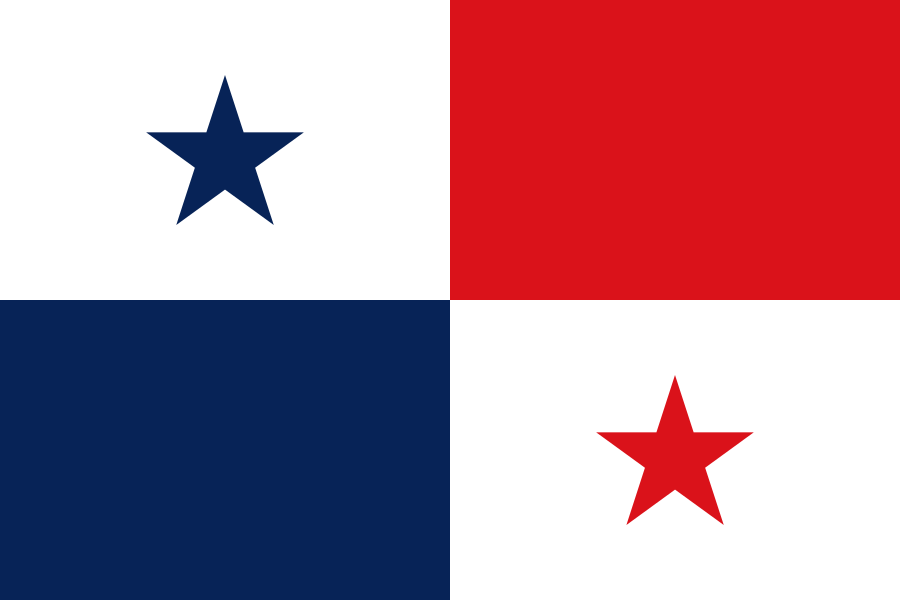
 Guide de l'expatrié à long terme · Panama
Guide de l'expatrié à long terme en Panama
Visas, voies de résidence, obligations fiscales et accès aux soins de santé pour les expatriés de longue durée
Guide de l'expatrié à long terme pour Panama
Relocating to Panama requires a clear understanding of its immigration policies, which are managed by the Servicio Nacional de Migración (National Immigration Service). Panama offers various pathways for temporary and permanent residency, as well as specific work authorizations.
Visa-Free Entry and Tourist Stay Limits
Many nationalities, including citizens of the United States, Canada, the United Kingdom, European Union countries, Australia, New Zealand, and numerous others, can enter Panama visa-free for tourism. The standard tourist stay limit is 90 days, though it can sometimes be extended up to 180 days at the discretion of immigration authorities. It's crucial not to overstay a tourist visa, as this can lead to fines and difficulties with future entries.
Temporary Residency Tracks
Panama offers several temporary residency options, typically valid for one to two years and renewable:
- Work Visas: These are tied to specific employment in Panama. Categories include:
- 10% Ordinary Workers Visa: For employees of Panamanian companies, limited to 10% of the company's workforce.
- 15% Specialist Workers Visa: For technical or specialized personnel, limited to 15% of the company's workforce.
- Friendly Nations Visa (Employment): While primarily a permanent residency path, it can initially grant temporary residency for those from specific 'friendly nations' who secure employment in Panama. This is a popular route for citizens of countries like the US, Canada, UK, EU nations, Australia, and many Latin American countries.
- Professional Visa: For foreign professionals with a university degree, working in a field not reserved for Panamanians.
- Student Visas: For foreigners enrolled in recognized educational institutions in Panama. Requires proof of enrollment, financial solvency, and a clean criminal record.
- Family Reunion and Dependent Visas: Available for spouses, children under 18 (or up to 25 if studying), and sometimes parents of a Panamanian citizen or a foreign resident. Proof of relationship and financial support is required.
Permanent Residency
Panama offers several attractive routes to permanent residency:
- Friendly Nations Visa: This remains one of the most popular options. Citizens from approximately 50 designated 'friendly nations' (including the US, Canada, UK, EU, Australia, etc.) can apply for permanent residency by demonstrating economic solvency through one of three options:
- Employment: Securing a job with a Panamanian company.
- Real Estate Investment: Purchasing real estate worth at least $200,000 USD (as of April 2026).
- Fixed-Term Deposit: Depositing $200,000 USD in a Panamanian bank for at least three years.
- Timeline: The process typically takes 3-6 months for initial approval, followed by a temporary resident card, then a permanent card.
- Pensionado / Retired Visa: For individuals with a guaranteed lifetime pension or annuity of at least $1,000 USD per month. An additional $250 USD per month is required for each dependent. This visa offers various benefits, including discounts on flights, hotels, and medical services.
- Qualified Investor Visa (Golden Visa): Introduced to attract significant foreign investment. Options include:
- Real Estate Investment: Investing $300,000 USD in real estate (can be reduced to $200,000 for certain projects).
- Securities Investment: Investing $500,000 USD through a Panamanian brokerage firm.
- Fixed-Term Deposit: Depositing $500,000 USD in a Panamanian bank for at least five years.
- Timeline: This program aims for a faster processing time, often within 30 days once all documentation is submitted.
- Reforestation Investor Visa: Investing at least $100,000 USD in a reforestation project approved by the Panamanian government.
- Self-Solvency Visa: For individuals who can demonstrate significant financial solvency through a fixed-term deposit of $300,000 USD in a Panamanian bank or real estate investment of the same amount.
Citizenship
Naturalization in Panama is possible after a period of permanent residency:
- Requirements: Generally, applicants must have held permanent residency for five years. This period can be reduced to three years for those married to a Panamanian citizen or with Panamanian-born children. Applicants must demonstrate proficiency in Spanish, knowledge of Panamanian history, geography, and civics, and have a clean criminal record. Renouncing previous citizenship is generally not required, as Panama allows dual citizenship.
- Timeline: The citizenship application process can be lengthy, often taking 2-5 years after the initial residency period is met.
Work Permits and Employment Authorization
Even with a residency visa, foreigners generally require a separate work permit to be legally employed in Panama. Work permits are issued by the Ministerio de Trabajo y Desarrollo Laboral (Ministry of Labor and Labor Development). The type of work permit depends on the residency category and the employer. Employers typically initiate the work permit application process on behalf of the foreign employee. Penalties for working without a permit are severe for both the employee and the employer.
Digital Nomad or Remote Worker Visa Programmes
Panama launched a Temporary Resident Visa for Remote Workers in 2021, which has been extended and remains active as of April 2026. This visa allows individuals working remotely for companies outside Panama to reside in the country for an initial period of nine months, renewable once for an additional nine months, for a total of 18 months.
- Key Requirements:
- Proof of employment by a foreign company or self-employment with foreign clients.
- Minimum monthly income of $3,000 USD (or $4,000 USD if including dependents).
- Proof of private health insurance valid in Panama.
- Clean criminal record.
- Affidavit stating the work is performed remotely and outside Panamanian territory.
- Application is made through the Servicio Nacional de Migración.
Application Process
- Where to Apply: Most residency applications are submitted in Panama through a local immigration lawyer, who is legally required to represent applicants. Tourist visas are typically obtained at a Panamanian consulate or embassy in the applicant's home country, if required.
- Documentation: Common documents include a valid passport, multiple passport-sized photos, criminal background checks (apostilled or legalized), marriage/birth certificates (apostilled or legalized), health certificate from a Panamanian doctor, financial solvency proof, and specific documents related to the visa category. All foreign documents must be translated into Spanish by a certified public translator in Panama.
- Fees: Government fees vary significantly by visa type, ranging from a few hundred to several thousand USD. For example, the Friendly Nations Visa government fees can be around $2,000 - $3,000 USD (excluding legal fees). Digital Nomad visa fees are typically lower, around $500 - $1,000 USD. Legal fees are additional and can range from $1,500 - $5,000+ USD depending on the complexity.
- Timelines: Processing times vary greatly, from 30 days for the Qualified Investor Visa to several months for other residency categories. Work permits are processed separately and can take 1-3 months.
Renewal Procedures
Temporary residency visas and work permits require timely renewal before expiration. The process generally involves submitting updated documentation, proof of continued eligibility, and payment of renewal fees. Permanent residency cards are typically renewed every 10 years.
Common Pitfalls and Refusal Reasons
- Incomplete or Incorrect Documentation: This is the most common reason for delays or refusals. Ensure all documents are apostilled/legalized and translated correctly.
- Overstaying Tourist Visa: Can result in fines and complicate future immigration processes.
- Lack of Financial Solvency: Not meeting the minimum income or investment requirements for the chosen visa category.
- Criminal Record: Serious criminal offenses will lead to refusal.
- Misrepresentation: Providing false information or documents.
- Not Engaging Legal Counsel: While not strictly mandatory for all steps, a local immigration lawyer is highly recommended for residency applications due to the complexity of Panamanian law and the requirement for legal representation in many processes.
Panama operates a territorial tax system, which is a significant advantage for many expats. Understanding your tax obligations is crucial for long-term residency. The primary tax authority is the Dirección General de Ingresos (DGI).
Tax Residency Rules
A foreigner generally becomes a tax resident in Panama if they spend more than 183 days in the country within a calendar year, or if their primary economic interests are located in Panama. However, Panama's territorial tax system means that tax residency primarily determines what income is subject to Panamanian tax, not necessarily all worldwide income.
Income Tax Rates and Brackets
Panama's territorial tax system means that only income generated from sources within Panama is subject to Panamanian income tax. Income earned outside Panama, even by a Panamanian tax resident, is generally not taxed in Panama.
For Residents (Panamanian-sourced income): Income tax is progressive:
- Up to $11,000 USD per year: 0%
- From $11,001 USD to $50,000 USD per year: 15% on the excess over $11,000
- Over $50,000 USD per year: 25% on the excess over $50,000
For Non-Residents (Panamanian-sourced income): Non-residents are generally subject to a flat withholding tax rate on their Panamanian-sourced income, which can vary depending on the type of income (e.g., professional fees, royalties). This is typically a 12.5% withholding tax on gross income.
Double Taxation Treaties
Panama has signed Double Taxation Treaties (DTTs) with several countries to prevent individuals and companies from being taxed twice on the same income. Key countries with active DTTs with Panama include:
- Mexico
- Spain
- Portugal
- Netherlands
- United Kingdom
- France
- South Korea
- Qatar
- United Arab Emirates
- Barbados
- Luxembourg
- Ireland
- Singapore
- Vietnam
These treaties help clarify which country has the right to tax specific types of income and can provide relief from double taxation. It is advisable to consult a tax professional regarding the specifics of any DTT.
Social Security and Pension Contributions
For employed foreigners working in Panama, contributions to the Caja de Seguro Social (CSS - Social Security Fund) are mandatory. Both the employee and the employer contribute a percentage of the employee's salary.
- Employee Contribution: Approximately 9.75% of gross salary (as of April 2026).
- Employer Contribution: Approximately 12.25% of gross salary (as of April 2026).
These contributions cover public healthcare, disability, and retirement benefits. Self-employed individuals can voluntarily contribute to the CSS to gain access to benefits.
Tax Filing Requirements, Deadlines, and How to File
- Requirements: Individuals who earn Panamanian-sourced income above the tax-exempt threshold are required to file an annual income tax declaration.
- Deadlines: The deadline for individual income tax declarations is March 15th of the following year for the preceding tax year. Extensions can sometimes be requested.
- How to File: Tax declarations are typically filed electronically through the DGI's online portal. It is highly recommended to engage a local accountant for assistance, especially for your first filing.
Tax Deductions and Allowances Available to Expats
Panama offers limited tax deductions for individuals. These may include:
- Certain medical expenses (not covered by insurance).
- Educational expenses for dependents.
- Mortgage interest on a primary residence in Panama.
- Donations to approved charities.
It's important to keep accurate records and receipts for any claimed deductions.
Property Ownership Tax for Foreigners
Foreigners owning property in Panama are subject to Impuesto de Inmuebles (property tax). The rates are progressive and based on the registered value of the property:
- Properties valued up to $120,000 USD: Exempt if it's the primary residence.
- Properties valued over $120,000 USD: Progressive rates typically starting from 0.5% to 0.7% on the excess value, depending on whether it's a primary residence or secondary property/commercial property.
There are also transfer taxes when buying or selling property.
Capital Gains Tax
- Real Estate: Capital gains on the sale of real estate are subject to a 10% tax on the gain, or a 5% tax on the total sale price, whichever is higher. This is typically withheld by the buyer or their legal representative at the time of sale.
- Securities: Capital gains from the sale of securities (stocks, bonds) are generally taxed at 10%.
VAT and Other Indirect Taxes Affecting Daily Life
- ITBMS (Impuesto de Transferencia de Bienes Muebles y Servicios): This is Panama's equivalent of VAT or sales tax. The standard rate is 7% on most goods and services.
- Exceptions: Certain essential goods (food, medicines, some educational services) are exempt or taxed at a lower rate (e.g., 0% for basic foodstuffs). Hotel services are taxed at 10%.
- Other Taxes: There are also import duties on certain goods, excise taxes on alcohol and tobacco, and municipal taxes.
Wealth or Net Worth Taxes
Panama does not levy a wealth or net worth tax on individuals.
When to Engage a Local Tax Advisor
It is highly recommended to engage a qualified local tax advisor or accountant in Panama, especially if you:
- Have complex income streams (e.g., self-employment, multiple sources).
- Own a business in Panama.
- Have significant investments in Panama.
- Are unsure about your tax residency status or the application of DTTs.
- Need assistance with annual tax filings.
Penalties for Non-Compliance
Panama imposes penalties for non-compliance with tax obligations, including:
- Fines: For late filing of tax declarations or late payment of taxes.
- Interest: Charged on overdue tax amounts.
- Audits: The DGI can conduct audits, and discrepancies can lead to additional penalties.
- Legal Action: In severe cases of tax evasion, legal action may be pursued.
Panama offers a dual healthcare system comprising both public and private sectors. While the public system provides basic care, most expats opt for private healthcare due to its higher quality, modern facilities, and English-speaking staff, particularly in major urban centers like Panama City.
Healthcare System Overview
- Public Healthcare: Administered by the Caja de Seguro Social (CSS - Social Security Fund) and the Ministerio de Salud (MINSA - Ministry of Health). The CSS system is funded by mandatory contributions from employees and employers, while MINSA provides services to the general population, including those not covered by CSS, funded by the government budget. Public hospitals and clinics are available nationwide.
- Private Healthcare: Consists of numerous private hospitals, clinics, and specialists, predominantly concentrated in Panama City. This sector is funded primarily through private health insurance and out-of-pocket payments.
Access Rights for Foreigners
- Tourists: Have access to emergency services but are expected to pay out-of-pocket or through travel insurance. Public hospitals may provide basic emergency care, but private facilities are generally preferred for quality and speed.
- Residents & Workers:
- Foreigners who are legally employed in Panama and contribute to the CSS have access to the public healthcare system. This includes medical consultations, hospitalizations, and prescription medications within the CSS network.
- Foreign residents who are not employed or self-employed and choose not to contribute voluntarily to CSS, or those seeking higher standards of care, rely entirely on private healthcare and private insurance.
Health Insurance
- Required: Private health insurance is often a mandatory requirement for obtaining various residency visas (e.g., Digital Nomad Visa, Friendly Nations Visa). It's highly recommended for all expats, regardless of visa requirements.
- Public Coverage (CSS): If you are employed and contributing to CSS, you are covered for medical services within the CSS system. However, this system can experience long wait times, crowded facilities, and limited access to specialized care, especially outside Panama City.
How to Register with the Public Healthcare System as a Foreigner
If you are formally employed by a Panamanian company, your employer is responsible for registering you with the CSS and making the mandatory contributions on your behalf. You will receive a CSS card, which grants you access to public health services. Self-employed individuals or those not formally employed can sometimes opt for voluntary contributions to the CSS, but this process can be complex and may not be the preferred option for most expats.
Private Health Insurance
- Recommended Providers: Many international health insurance providers (e.g., Cigna, Aetna, Bupa) offer plans valid in Panama. Local Panamanian insurers like ASSA, Mapfre, and Blue Cross Blue Shield Panama also offer comprehensive plans. It's advisable to compare plans and ensure they cover the specific hospitals and doctors you prefer.
- Typical Costs: Private health insurance costs vary significantly based on age, coverage level, deductible, and pre-existing conditions. A comprehensive plan for an individual can range from $100 - $500+ USD per month (as of April 2026). Family plans will be higher. Many plans offer direct billing with major private hospitals in Panama City.
Quality of Public vs. Private Care in Practice
- Public Care: Generally provides adequate basic care, but facilities can be older, equipment less advanced, and wait times for appointments and procedures can be very long. English-speaking staff are rare. It serves as a safety net but is often not the preferred choice for expats.
- Private Care: Offers a significantly higher standard of care, especially in Panama City. Hospitals like Hospital Punta Pacífica (affiliated with Johns Hopkins Medicine International), Hospital Paitilla, and Centro Médico Nacional are modern, well-equipped, and have highly trained, often English-speaking, medical professionals. Wait times are minimal, and patient comfort is prioritized.
Emergency Services
- Access: The national emergency number is 911. This connects to police, fire, and ambulance services. For medical emergencies, an ambulance will be dispatched.
- What to Expect: In Panama City, private hospitals have excellent emergency rooms. If you have private insurance, you will typically present your card, and the hospital will verify coverage. Without insurance, you may be required to pay a deposit or the full cost upfront. Public hospital emergency rooms are available but can be overwhelmed and have longer waits.
Prescription Medications
- Availability: Prescription medications are widely available in pharmacies (farmacias) throughout Panama. Major pharmacy chains include Farmacias Arrocha and Farmacias Metro. Many common medications that require a prescription in other countries can be purchased over-the-counter in Panama.
- Cost: Medication costs are generally lower than in North America or Europe. It's advisable to carry a copy of your prescription from your doctor, especially for controlled substances.
Dental and Vision Care
- Public Coverage: The CSS offers very limited basic dental care, primarily extractions and basic fillings. Vision care is generally not covered.
- Out-of-Pocket/Private Insurance: Most expats rely on private dental and vision clinics. Panama City has many high-quality dentists and optometrists, often at more affordable prices than in Western countries. Private health insurance plans may offer optional dental and vision riders, or you can pay out-of-pocket.
Mental Health Services Available to Expats
Mental health awareness is growing in Panama. Private psychologists, psychiatrists, and therapists are available, particularly in Panama City. Many have international training and offer services in English. These services are typically paid out-of-pocket, though some comprehensive private health insurance plans may offer partial coverage.
Maternity Care and Childbirth Options
Panama offers excellent maternity care, especially in the private sector. Private hospitals provide modern facilities, experienced obstetricians, and comfortable birthing suites. Costs for private childbirth can range from $2,000 - $5,000+ USD for an uncomplicated delivery (as of April 2026), depending on the hospital and services. Public hospitals also offer maternity care through the CSS system, but with the limitations mentioned above.
Vaccinations and Travel Health Requirements
- Routine Vaccinations: Ensure all routine vaccinations (MMR, DPT, Polio, etc.) are up-to-date.
- Recommended Vaccinations:
- Hepatitis A and B
- Typhoid (especially if traveling to rural areas or eating outside major cities)
- Yellow Fever: Recommended for travelers to certain rural areas of Panama, particularly Darién Province, and may be required if arriving from a country with a risk of Yellow Fever transmission. Check current WHO and CDC guidelines.
- Other Health Considerations: Dengue fever, Chikungunya, and Zika virus are present, so mosquito bite prevention is crucial. Tap water is generally safe to drink in Panama City and major towns, but bottled water is recommended in rural areas. Consult your doctor or a travel clinic well in advance of your relocation.
Plus d'informations pour votre déménagement à Panama
Guides complets et analyses basées sur les données.
Budget et dépenses
Votre style de vie est-il abordable ? Des prix des courses aux factures, voyez comment les coûts se comparent à votre pays d'origine.
Lire le guideÉcoles et famille
Trouver la bonne école est une priorité. Comparez les écoles internationales et les normes curriculaires.
Lire le guideTransports
Comment se déplacer ? Couverture des transports en commun, aéroports et qualité des infrastructures en un coup d'œil.
Lire le guide